Table of Contents
What This Blog Will Help You Understand
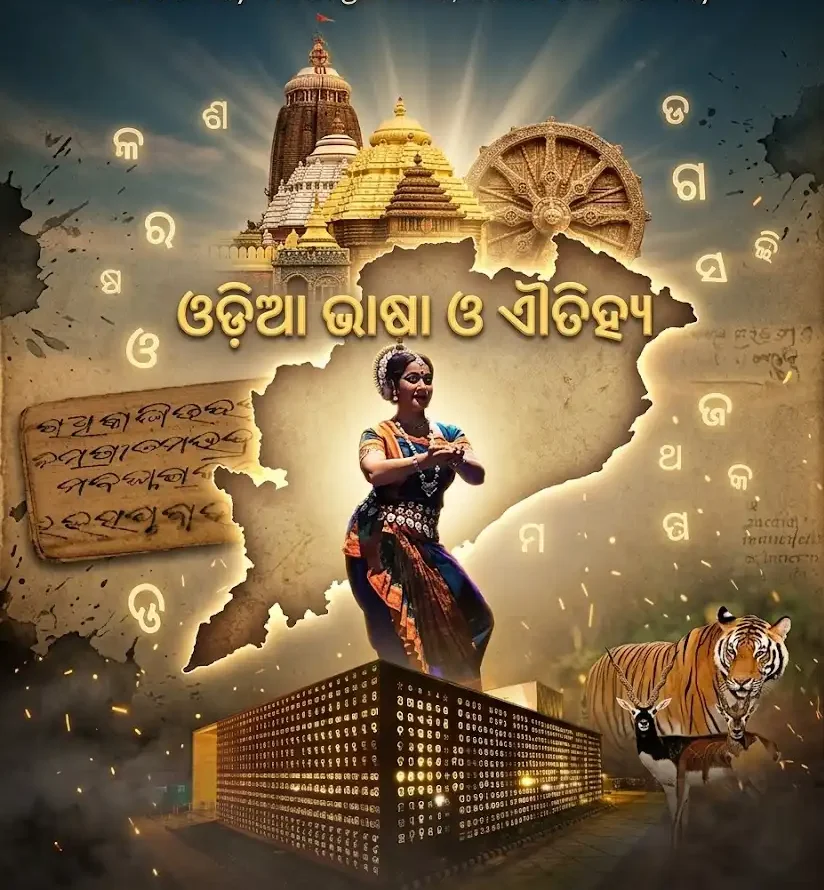
If you are curious about the Language Heritage of Odisha, this blog will guide you through its ancient roots, literary richness, cultural significance, and modern relevance.
More importantly, it will help you understand why Odia is not just a language, but a living identity.Why the Language Heritage of Odisha is So Unique
Odisha is often celebrated for its temples and beaches. However, its deepest treasure lies in its linguistic heritage.
The Odia language carries stories of kings, poets, saints, and common people across centuries.
Unlike many languages that changed significantly over time, Odia has preserved its original character and structure.
As a result, when you hear Odia today, you are listening to echoes of a civilization that is over 2,500 years old.
Moreover, the language connects people emotionally, culturally, and spiritually.A Classical Legacy: The Ancient Roots of Odia Language
In 2014, Odia received the prestigious status of a Classical Language of India.
This recognition was not sudden, it was the result of its long and rich history.
Where It Began:
- Originated from Odhra Magadhi Prakrit
- Mentioned in ancient texts like Natyashastra
- Retains strong Sanskrit influence
What Makes It Special:
- Over 2,500 years’ old
- Minimal foreign influence compared to other Indo-Aryan languages
- Strong phonetic consistency
Stone Inscriptions & Historical Evidence
The story of the Language Heritage of Odisha is literally carved into stone.
Key Historical Records:
- Ashokan Edicts (3rd Century BCE)
- Found in Dhauli and Jaugada, these inscriptions reflect early linguistic forms.
- Hathigumpha Inscription (1st Century BCE)
- Commissioned by Emperor Kharavela, it showcases advanced governance and language development.
Maritime Influence:
- Bali
- Java
- Thailand
The Birth of Odia Literature
Charyapada – The Beginning
Between the 8th and 12th centuries, mystical poems called Charyapadas marked the early form of Odia.
Sarala Das – The First Poet (Adikabi)
In the 15th century, Sarala Das translated the Mahabharata into Odia.
Why It Was Revolutionary:
- Simplified complex Sanskrit text
- Made literature accessible to common people
- Unified regional dialects
The Pancha Sakha Era
- Balarama Das
- Jagannatha Das
- Achyutananda Das
- Ananta Das
- Yasovanta Das
The Birth of Odia Literature
Charyapada – The Beginning
Between the 8th and 12th centuries, mystical poems called Charyapadas marked the early form of Odia.
Sarala Das – The First Poet (Adikabi)
In the 15th century, Sarala Das translated the Mahabharata into Odia.
Why It Was Revolutionary:
- Simplified complex Sanskrit text
- Made literature accessible to common people
- Unified regional dialects
The Pancha Sakha Era
- Balarama Das
- Jagannatha Das
- Achyutananda Das
- Ananta Das
- Yasovanta Das
Language & Culture: A Deep Connection
Odia is not just spoken, it is performed, sung, and painted.
Odissi Dance
- Based on Odia literature
- Uses poetry for storytelling
Pattachitra Art
- Includes Odia scripts in paintings
- Combines visual art with language
Jagannath Culture
- Devotional songs (Bhajans, Jananas) in Odia
- Language acts as a bridge between devotee and deity
1936: Language That Created a State
During British rule, Odia faced threats from other dominant languages. However, this led to a powerful movement.
Key Figures:
- Madhusudan Das
- Fakir Mohan Senapati
- Radhanath Ray
Historic Moment:
On April 1, 1936, Odisha became the first state in India formed on a linguistic basis.
This proves the importance of Odia language in shaping regional identity.Odia Language in the Digital Age
While globalization poses challenges, technology is opening new opportunities.
Modern Developments:
- Odia blogs and digital content
- Social media communities
- Odia Wikipedia
- AI and translation tools
Importance of Odia Language in Today’s World
The Language Heritage of Odisha is important because it:
- Preserves cultural identity
- Connects generations
- Promotes regional pride
- Enriches Indian diversity
People Also Ask (FAQs)
1. Why is Odia considered a classical language?
Because of its ancient origin, rich literature, and independent linguistic tradition.
2. What is the origin of Odia language?
It evolved from Odhra Magadhi Prakrit over 2,500 years ago.
3. Who is the father of Odia literature?
Sarala Das is known as the Adikabi (first poet).
4. Why is Odia script rounded?
It was designed to prevent palm leaves from tearing during writing.
5. What is the importance of Odia language today?
It preserves culture, identity, and heritage while adapting to modern technology.
All answers are based on traditional understanding and historical references.A Living Language: Experience Beyond Words
When you hear Odia spoken in villages, temples, or markets, it feels alive.
It carries emotion, history, and simplicity all at once.
- A devotional song in Puri
- A poem in a village gathering
- A conversation in Bhubaneswar
Preserve & Celebrate the Language Heritage of Odisha
The Language Heritage of Odisha is not just history—it is a living legacy.
- Learn a few Odia words
- Read Odia literature
- Support local content creators
- Visit Odisha and experience its culture
Final Thoughts
The Language Heritage of Odisha represents resilience, culture, and identity.
It is a language that has adapted yet remained rooted.Trending Posts