
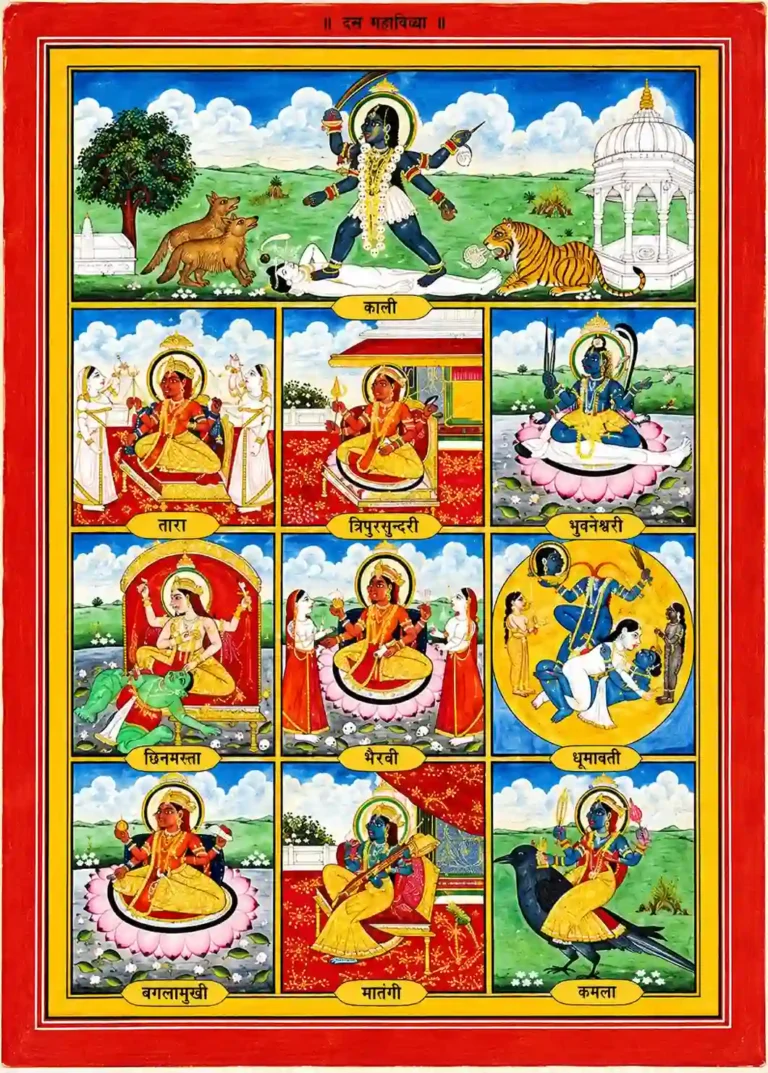
The Story of Sati and the Ten Mahavidyas
The best-known origin story begins with Sati, daughter of Daksha Prajapati and wife of Shiva. Daksha arranged a great yajna and pointedly left Sati and Shiva off the invitation list. Sati still wished to go. Shiva tried to stop her. What followed is one of the key narratives of the tradition: Sati manifested the ten Mahavidyas and stationed them around Shiva in the ten directions. The episode is frequently cited to show that these ten forms are expressions of a single Shakti.
It also accounts for the striking variety among them. The same power can show itself as a fierce destroyer, a young goddess of beauty, an aged widow, a mistress of learning, or a bestower of prosperity.
Kali
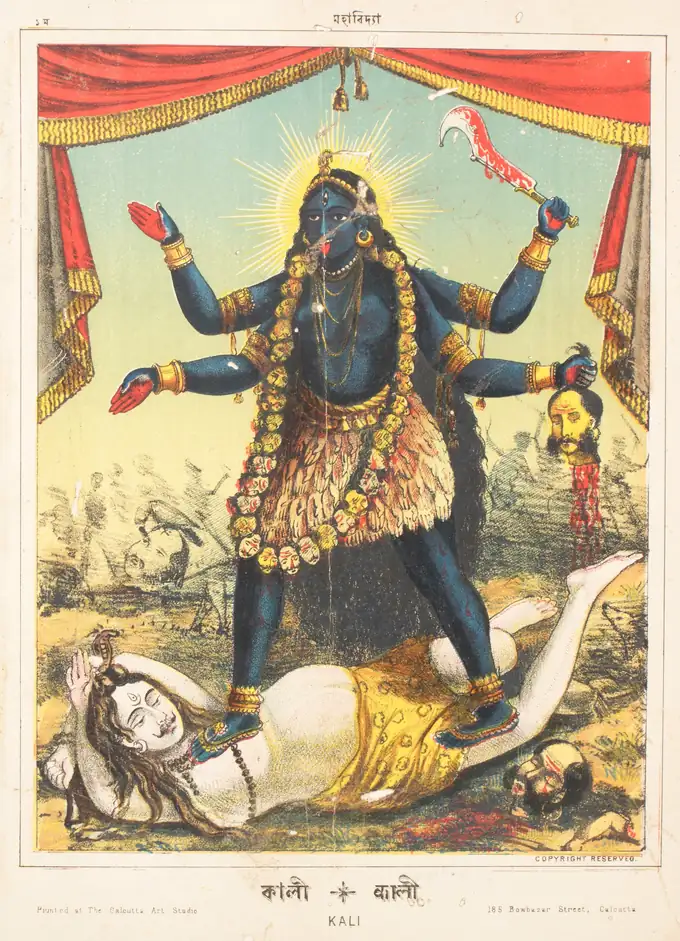
Kali stands first in the traditional order. Dark-skinned, three-eyed and four-armed, she is one of the most immediately recognisable forms of the Goddess.
Her iconography does not soften the reality of death. She stands on a corpse, sword and freshly severed head in two hands, a garland of human heads around her neck. The Raktabija episode forms part of the background to this fierce appearance. Yet devotees do not see her only as terrifying. The remaining hands offer protection and blessing. She is worshipped as the Mother who can guide a seeker toward liberation. Her Bhairava is Mahakala.
Tara
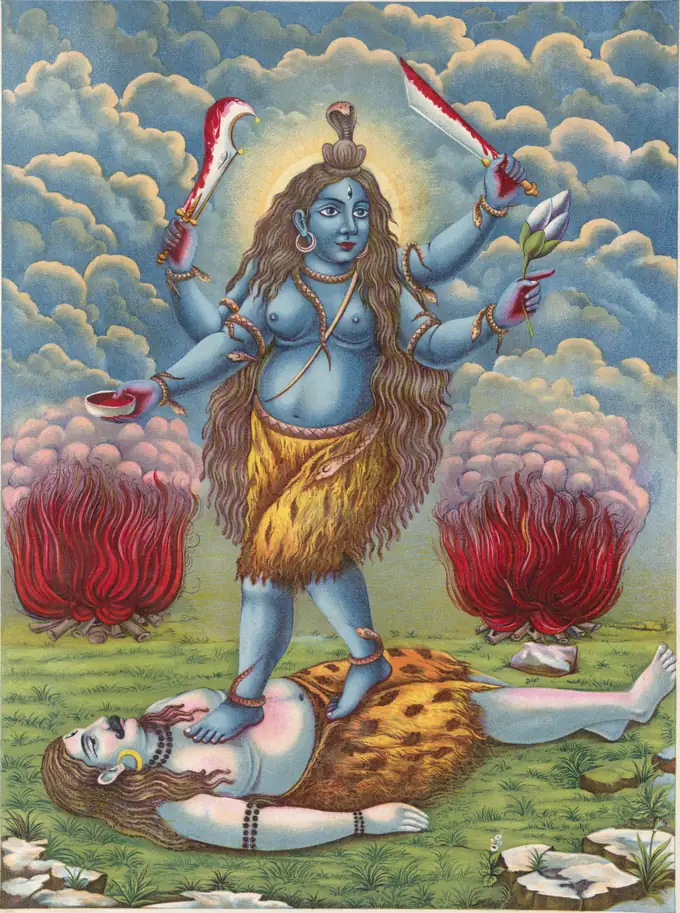
Tara, the second Mahavidya, shares several visual traits with Kali. Her complexion is deep blue. She is also known as Nilasaraswati, Ugratara and Ekajata.
In her four hands she holds a sacrificial sword, a severed head or skull-cup, a lotus and a pair of scissors. Traditionally she is shown with one foot resting on Shiva, who lies beneath her. What sets Tara apart is the breadth of her worship. She appears in Tibetan Buddhist traditions and in Jain contexts as well. Within the Mahavidya system her Bhairava is Akshobhya.
Shodashi, or Tripura-Sundari
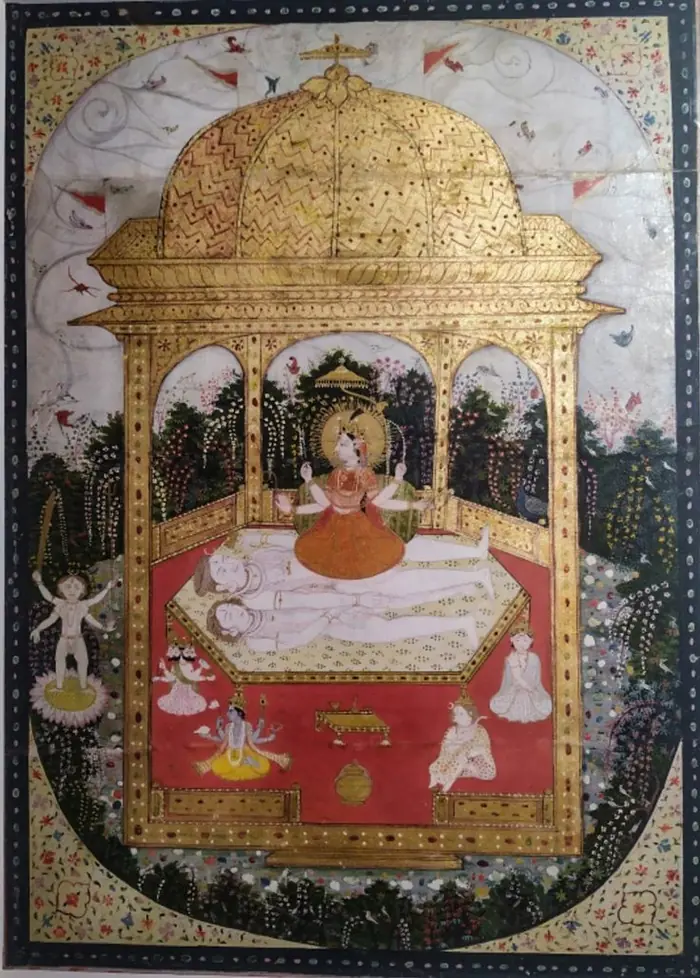
After the dark intensity of Kali and Tara comes a markedly different expression of Shakti. Shodashi is identified with Tripura-Sundari and is also called Lalita, Srividya, Rajarajeswari and Kameshwari.
She is depicted as a sixteen-year-old girl of red-and-golden complexion. Her four hands hold a noose, a goad, a sugarcane bow and five flower-arrows. Beauty matters in her iconography, yet it is never only physical. The tradition links beauty with knowledge, grace, resolve and spiritual attainment. Her Bhairava is Kamesvara.
Bhubaneshwari
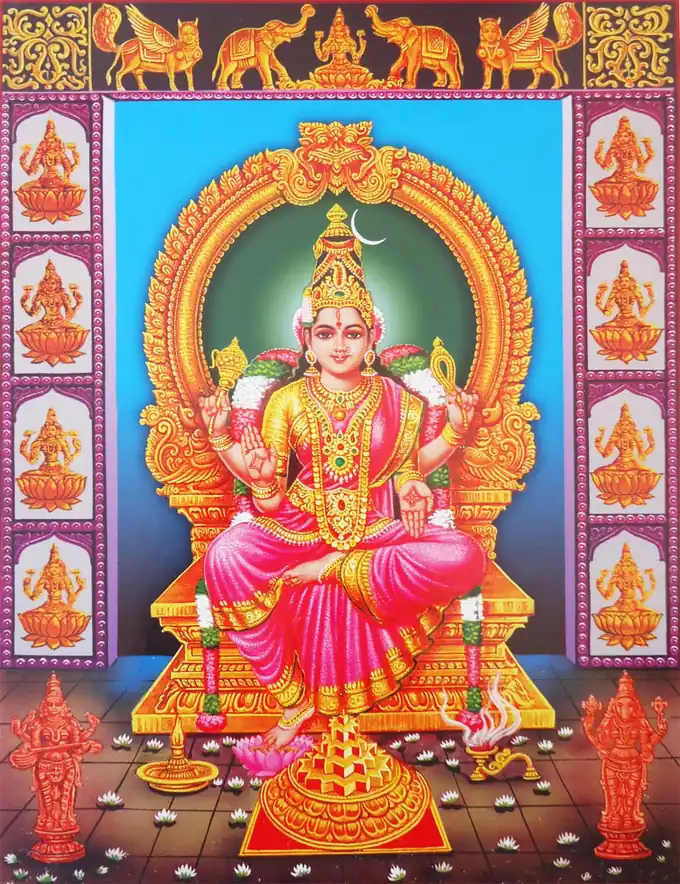
Bhubaneshwari is the fourth. Her name is commonly rendered "Mistress of the World," though her domain extends beyond the physical earth. She is linked to the three worlds — heaven, atmosphere and earth — and therefore carries a cosmic character.
Her complexion is compared to the rising sun. She wears a crown and crescent moon and has three eyes. Two hands hold the noose and goad; the other two display the gestures of granting boons and removing fear. Those three eyes are associated with ichha shakti, kriya shakti and jnana shakti — the powers of desire, action and knowledge. Her Bhairava is Tryambaka Shiva.
Bhairavi
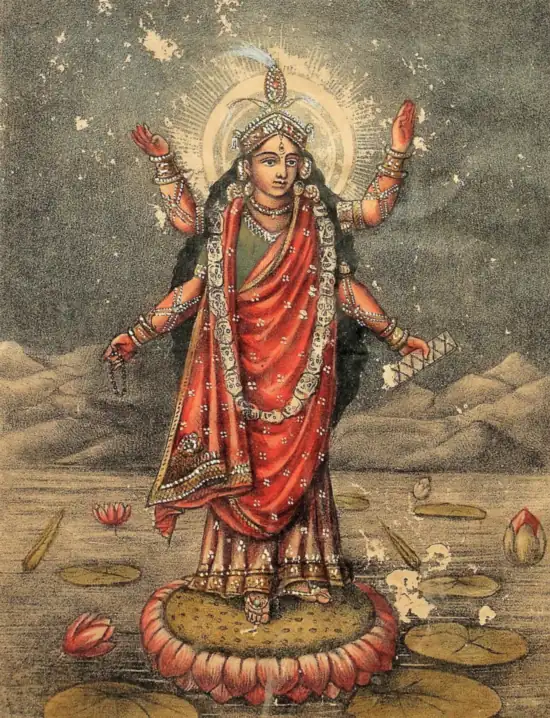
Bhairavi is another fierce form of Devi. At first glance she can recall Kali. She is particularly linked with Kala Bhairava.
She wears silk garments and a garland of heads. Her radiance is said to equal thousands of rising suns; her three eyes are likened to red lotuses. She carries a rosary and a book, while the remaining hands show gestures of blessing and protection. The combination is striking: the formidable and the disciplined appear together. The rosary and book bring learning and spiritual practice into an otherwise intense form. Her Bhairava is Dakshinamurti.
Chhinnamasta
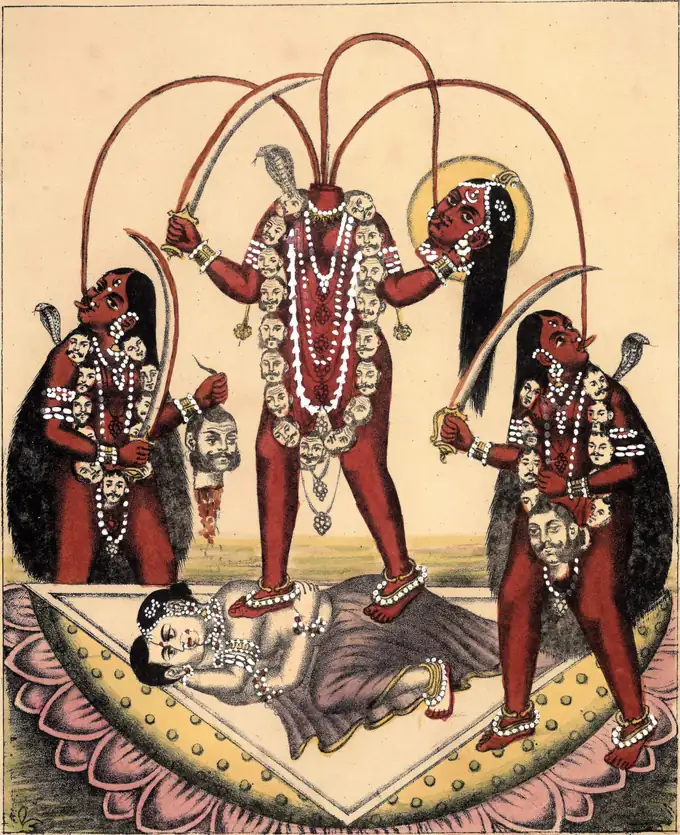
Chhinnamasta is one of the hardest images to take in at once. She is the headless Goddess, and her iconography makes no concessions.
She is shown with dishevelled hair, a sword and a garland of human heads. A serpent serves as her sacred thread. Two attendants, Dakini and Sakini, drink the blood that streams from her neck. She is also known as Prachanda Chandika. The image places sacrifice, the body and transformation at the centre. Her Bhairava is Kavandha.
Dhumavati
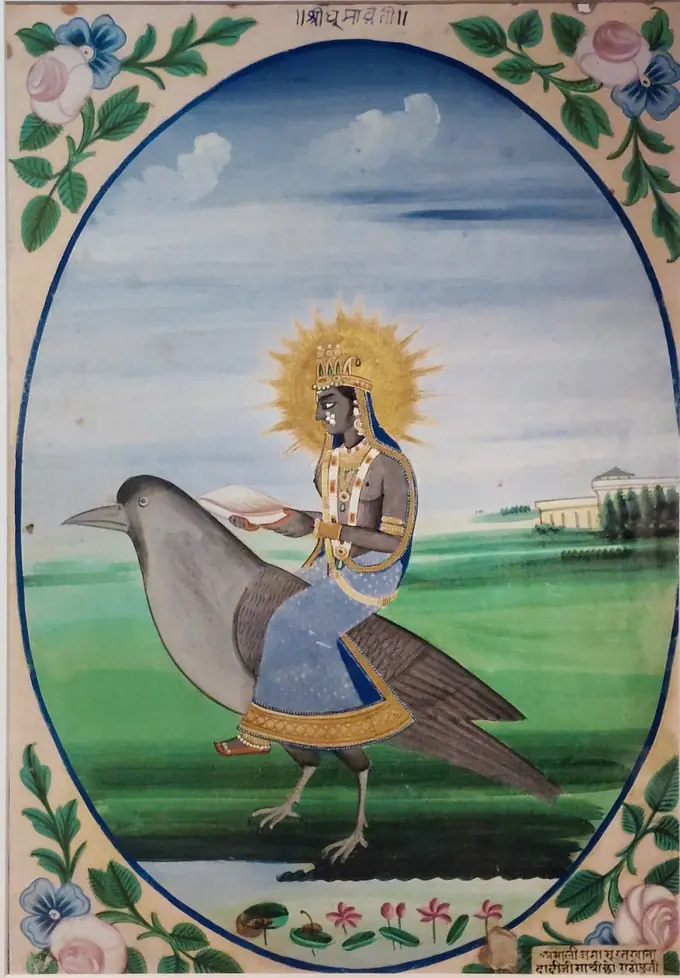
Dhumavati departs furthest from conventional goddess imagery. She appears as an old widow rather than a youthful or richly adorned deity.
Traditional depictions show a horseless chariot or a crow, and she is sometimes linked with cremation-ground settings. She carries a winnowing fan and displays a gesture of granting boons. What matters most is what her form refuses to conceal. Age, widowhood, loss and the harder sides of existence are brought into the religious image instead of being set aside. Her worship is associated with siddhi, relief from difficulties, knowledge, fulfilment of desires and moksha. Alone among the ten, Dhumavati is traditionally described without a Bhairava.
Bagala
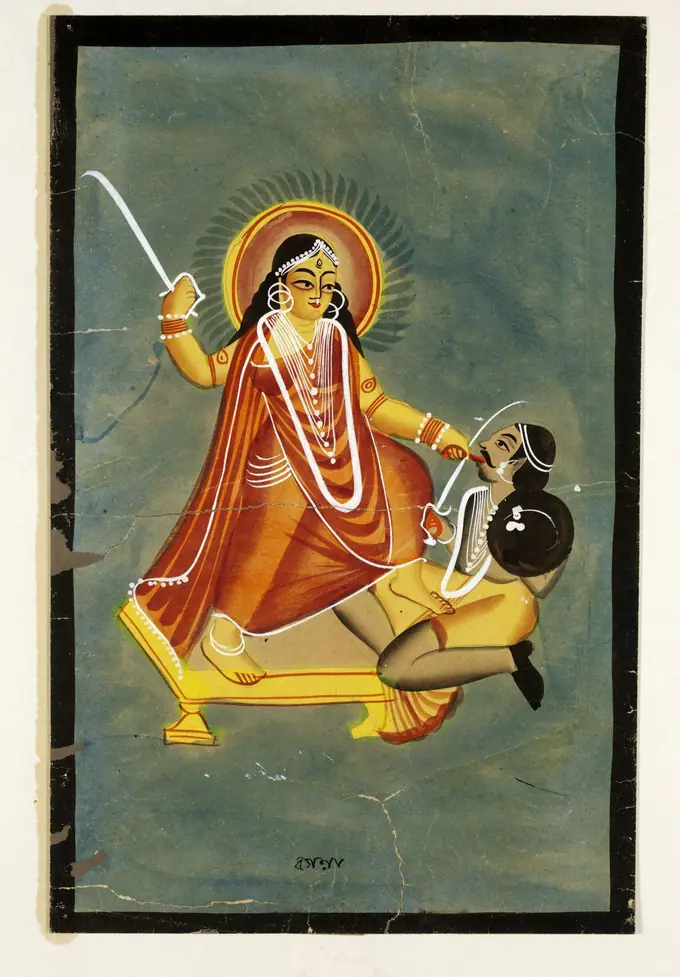
Bagala, the eighth, is closely tied to speech and the power of restraint. She has a yellow complexion, three eyes, and sits on a golden throne.
Her four hands hold a trident, a cup, a mace and the tongue of a demon. The imagery is forceful; she is associated with stopping or controlling opposing forces. In philosophical readings she is linked with the ending of dualities (dwandas). Her Bhairava is Ekavaktra Shiva.
Matangi
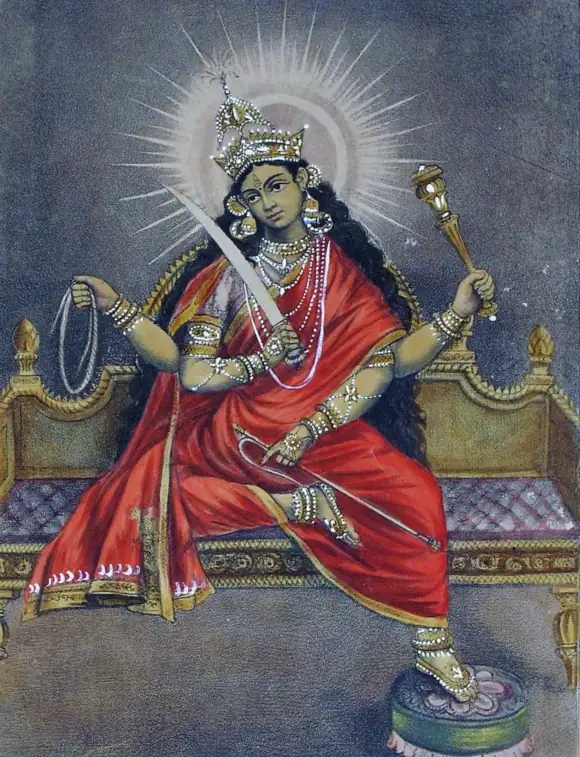
Matangi (also Matangini) is the ninth. Her dark emerald complexion and crescent moon set her apart visually.
Her strongest associations are music, art and learning. The veena in her iconography connects her with Saraswati; within the Mahavidya tradition she is regarded as a Tantric form of Saraswati. Several forms are named — Uchhista Matangini, Raja Matangini, Sumukhi Matangini, Vasya Matangini and Karna Matangini among them. Her worship is linked with mastery of the arts, knowledge and spiritual accomplishment. Her Bhairava is Dakshinamurti.
Kamala
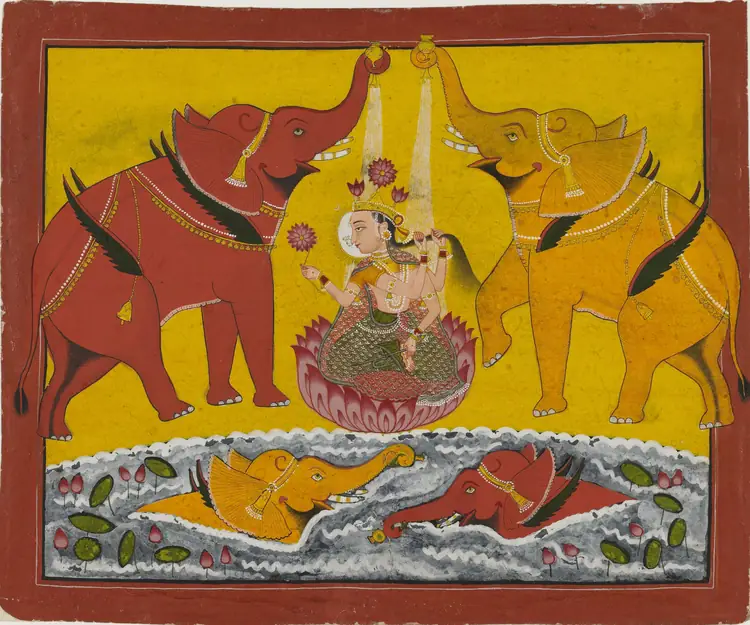
Kamala completes the series and is closely identified with Lakshmi. Her presence stands in clear contrast to the cremation-ground imagery of several earlier forms.
She sits on a lotus, golden in complexion. Two hands hold lotuses; the other two offer blessings. Two elephants stand beside her, trunks raised, pouring water. The elephants and water evoke fertile rain and the growth of vegetation. In spiritual terms that growth becomes an image of spiritual wealth arising through devotion and practice. Her Bhairava is Sri-Vishnu.
The Ten Mahavidyas and Their Bhairavas
The Mahavidyas are traditionally paired with Bhairavas, understood as forms of Shiva. These pairings add another layer to Shakta and Tantric worship.
| Mahavidya | Bhairava |
|---|---|
| Kali | Mahakala |
| Tara | Akshobhya |
| Shodashi | Kamesvara |
| Bhubaneshwari | Tryambaka Shiva |
| Bhairavi | Dakshinamurti |
| Chhinnamasta | Kavandha |
| Dhumavati | None |
| Bagala | Ekavaktra Shiva |
| Matangi | Dakshinamurti |
| Kamala | Sri-Vishnu |
Why the Ten Forms Matter
The Mahavidyas are clearest when their differences remain visible. Kali brings death and destruction into the sacred image. Tara carries fierce wisdom. Shodashi introduces beauty and grace. Bhubaneshwari expands the Goddess into the cosmos. Bhairavi joins fierce power with the imagery of prayer and learning. Chhinnamasta turns the body itself into a potent religious symbol. Dhumavati refuses the usual signs of youth and prosperity. Bagala concerns speech and restraint. Matangi brings music, art and knowledge into the group. Kamala stands for prosperity, fertility and well-being.
There is no requirement to smooth these forms into similarity in order to grasp their unity. Their differences are exactly what give the Dasha Mahavidya tradition its distinctive character.
Dasha Mahavidya and Shakta Tantra
The Mahavidyas hold a significant place in Shakta and Tantric traditions. Each goddess has her own names, iconography, associated Bhairava and modes of worship. The tradition is more than a list of ten deities. It offers multiple ways of approaching Shakti — forms that range from the terrifying to the nurturing, from the unconventional to the richly auspicious. Their imagery is meant to be contemplated and engaged within the living religious contexts in which these goddesses are worshipped.
Frequently Asked Questions About Dasha Mahavidya
What does Dasha Mahavidya mean?
Dasha Mahavidya means the Ten Wisdom Goddesses. Maha means great; vidya refers to wisdom, knowledge, manifestation or revelation.
Who are the ten Mahavidyas?
Kali, Tara, Shodashi, Bhubaneshwari, Bhairavi, Chhinnamasta, Dhumavati, Bagala, Matangi and Kamala.
What is the story behind the Dasha Mahavidya?
A well-known tradition links the ten forms with Sati. After the dispute over Daksha's yajna, Sati manifested the Mahavidyas around Shiva in the ten directions.
Which Mahavidya is associated with Lakshmi?
Kamala is closely identified with Lakshmi and linked with wealth, fertility, prosperity and well-being.
Which Mahavidya is associated with Saraswati?
Matangi is regarded as a Tantric form of Saraswati and associated with music, art and learning.
Which Mahavidya is represented as an old widow?
Dhumavati appears as an old widow and holds a distinctive place among the ten for that reason.
Which Mahavidya has no Bhairava?
Dhumavati is traditionally described without a Bhairava.
Which Mahavidya is Tripura-Sundari?
Shodashi is identified with Tripura-Sundari and is also known as Lalita, Srividya, Rajarajeswari and Kameshwari.
Conclusion
The Dasha Mahavidya gathers ten very different images of the Divine Mother into a single tradition. Kali, Tara, Shodashi, Bhubaneshwari, Bhairavi, Chhinnamasta, Dhumavati, Bagala, Matangi and Kamala do not simply repeat one idea ten times. Each carries its own visual language, story and place within Shakta thought.
That range is what makes the Mahavidyas compelling. Fierce and gentle, youthful and aged, austere and prosperous — they allow Shakti to be approached through a far wider span of human and spiritual experience.