Table of Contents
The Obscure Early Life of Siddheswar Parida
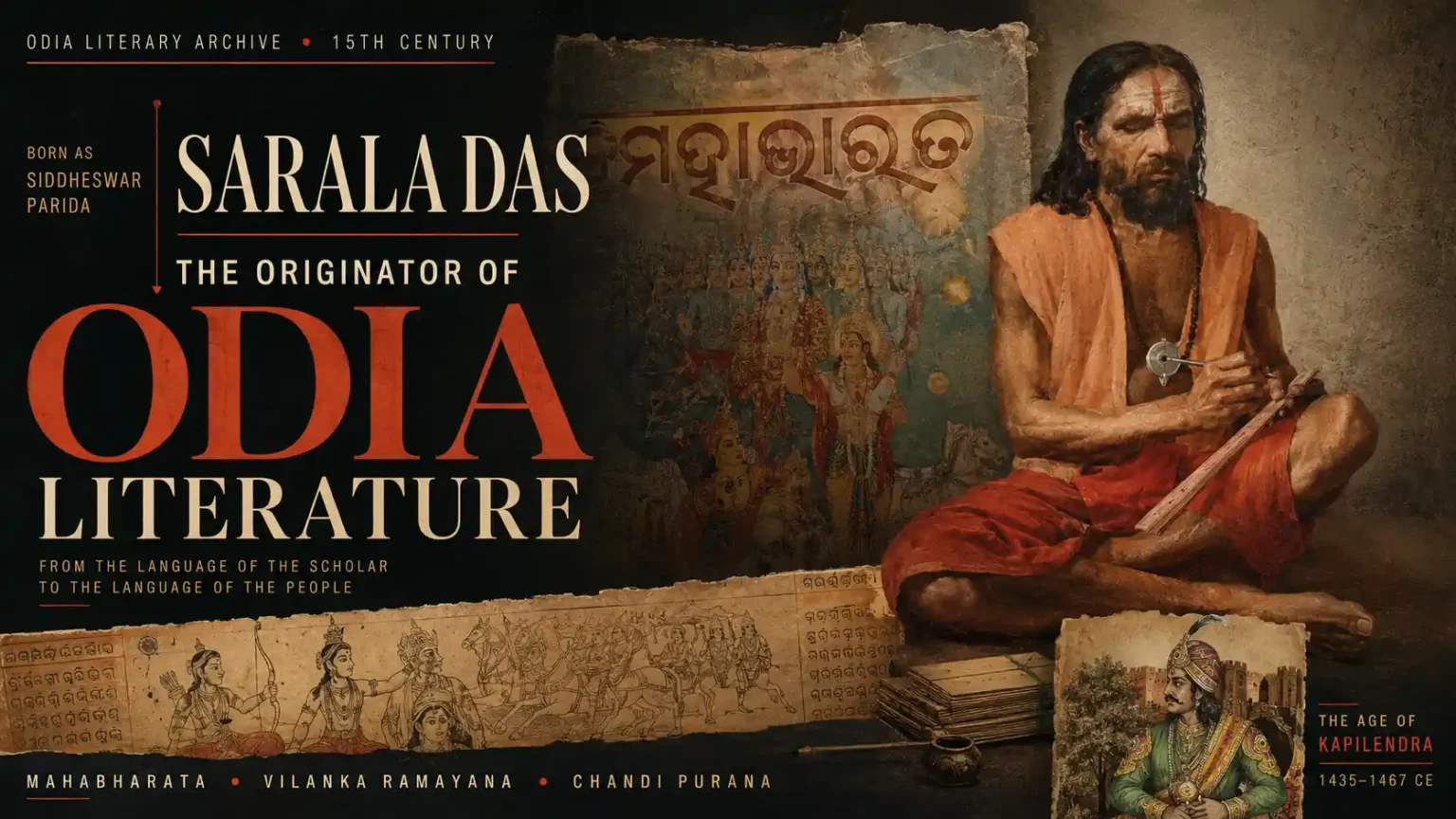
The early life of Sarala Das remains surrounded by uncertainty. His exact birth date cannot be established with confidence, although he is placed in the second half of the 15th century. He was born at Kanakavati Patana, now identified with Kanakapura in Jagatsinghpur district, traditionally regarded as one of the Siddha Kshetras of Odisha.
Before becoming known as Sarala Das, he was called Siddheswar Parida. He belonged to a cultivating family and did not receive a systematic formal education in his early years. His remarkable literary achievement is therefore particularly striking: much of his learning was understood to have come through self-education, observation and relentless effort.
The Blessing of Goddess Sarala
A popular traditional account connects Siddheswar's transformation into a poet with Goddess Sarala, the presiding deity of the region.
According to the story, while young Siddheswar was ploughing his father's field, he sang so beautifully that Goddess Sarala stopped to listen. She then blessed him with the power to compose poetry. It was through this association with the goddess that Siddheswar came to be known as Sarala Das.
Whether understood literally, spiritually or as a poetic tradition surrounding his life, the story captures something fundamental about Sarala Das's legacy: his literary voice emerged from the soil and lived experience of Odisha rather than from an exclusive scholastic tradition.
Sarala Das and the Age of Kapilendra
Sarala Das's literary career belongs to an important period in Odisha's history—the reign of Gajapati King Kapilendra, also known as Kapileswar, who ruled from 1435 to 1467 CE. His Mahabharata begins with an invocation to Lord Jagannatha and indicates that Sarala Das began composing the work during Kapilendra's reign.
The political atmosphere of this period appears to have played an important role in shaping the literary culture of Odisha. Kapilendra's strong rule, territorial expansion and the growing sense of regional identity created an environment in which people could develop greater pride in their land, language and culture.
For Sarala Das, however, this world was not something observed from a distance.
The Poet Who Was Also a Soldier
Several indications in his Mahabharata suggest that Sarala Das served as a soldier in the army of the Gajapati king. His military experience gave him access to a world far removed from the traditional image of the isolated court poet.
The army exposed him to battlefields, different places, historical incidents, people, stories and firsthand experiences. These memories became part of the imaginative material of his writing.
This may help explain why war rather than romantic love is the predominant emotional force in much of his poetry. His descriptions of conflict carry a sense of experience and observation that distinguishes his work from a purely scholastic retelling of ancient epics.
In Sarala Das, therefore, the soldier and poet became inseparable. The battlefield widened his geographical and cultural horizon; the poet transformed those experiences into literature.
The Three Great Works of Sarala Das
Sarala Das's reputation rests principally on three monumental works:
- Odia Mahabharata
- Vilanka Ramayana
- Chandi Purana
He is also associated with Laxmi Narayana Vachanika.
Together, these works demonstrate his extraordinary ability to take established Sanskrit narratives and recreate them through an Odia cultural lens.
The Odia Mahabharata: More Than a Translation
Sarala Das's Mahabharata follows the broad framework of the Sanskrit Mahabharata, but it should not be understood as a straightforward translation.
He departed from the original at numerous points, introducing stories and details of his own creation as well as material drawn from his knowledge and experience. In its completed form, the work became something substantially new—a distinctly Odia literary creation based upon the Sanskrit epic.
This distinction is crucial.
Making the Mahabharata Odisha's Own
Sarala Das brought the epic closer to the cultural world of his readers. Rather than preserving the Sanskrit text as an untouchable literary monument, he recreated its narrative universe in a language and style that ordinary Odias could understand.
The result was an epic that could be heard, understood, remembered and shared among common people.
His Mahabharata is consequently important not simply because it introduced an enormous Sanskrit epic into Odia, but because it demonstrated that Odia itself was capable of carrying a monumental literary tradition.
Vilanka Ramayana: A Different Rama-Ravana Conflict
Vilanka Ramayana is regarded in the source as Sarala Das's earliest work. Instead of reproducing the familiar Ramayana narrative, it focuses on a distinctive episode—the battle between Rama and Sahasrasira Ravana, the thousand-headed Ravana.
This work reflects Sarala Das's characteristic freedom as a creative poet. He did not see inherited mythology as something that had to be reproduced word for word. He treated it as a living narrative tradition that could be reshaped through his own imagination.
Chandi Purana: The Goddess in an Odia Voice
The Chandi Purana draws upon the well-known Sanskrit tradition of Goddess Durga's battle with Mahishasura, the buffalo-headed demon. Yet Sarala Das again departed from the original narrative at several points.
Through such creative adaptations, stories rooted in Sanskrit religious literature became part of a distinctly Odia literary world.
His religious writing also had a clear social purpose. Sarala Das sought to compose religious works in a language intelligible to the general public, expressing the idea that literature should benefit human beings rather than remain restricted to a learned elite.
The Revolutionary Language of Sarala Das
Perhaps Sarala Das's greatest revolution was linguistic.
At a time when Sanskrit dominated formal literary culture, Sarala Das chose to write in the language people actually spoke and understood. His poetry was simple, powerful and musical, and the source emphasizes his skill in using colloquial words without artificial Sanskritization.
From Scholarly Language to People's Language
This decision fundamentally changed who could participate in literature.
Instead of creating poetry primarily for Sanskrit-educated scholars, Sarala Das opened literary expression to the wider population. His language carried the rhythms and vocabulary of everyday Odisha.
His work therefore represents more than a literary achievement. It represents a cultural democratization of knowledge.
The epics were no longer distant stories belonging only to classical texts. They could become part of the oral and cultural memory of ordinary people.
The Folk Roots of His Poetry
Sarala Das's poetic style was also connected with Odisha's existing oral traditions.
Before him, Odia folk songs were widely performed and transmitted orally through traditions associated with forms such as Ghoda Nacha, Danda Nacha and Sakhinacha. These songs possessed distinctive metrical characteristics, including lines whose endings produced corresponding sounds despite differences in their length.
The works of Sarala Das display similar metrical characteristics. This suggests a strong connection between his literary compositions and the folk-poetic traditions that already existed in Odisha.
He did not simply create literature for the people.
He created literature from a cultural world that already belonged to the people.
Why Sarala Das Remains Important Today
Sarala Das's importance extends far beyond the historical value of his books.
He Gave Odia a Literary Identity
By demonstrating that Odia could carry epic narratives of enormous scale and complexity, Sarala Das helped establish the language as a powerful medium of literary expression.
He Made Literature Accessible
His use of colloquial language brought religious and epic narratives closer to ordinary people. Literature could be understood without requiring mastery of Sanskrit.
He Made Adaptation a Creative Act
Sarala Das did not merely translate. He interpreted, expanded, localized and recreated. His works show how a civilization can inherit a classical tradition while giving it a distinctly regional voice.
He Carried the Experiences of His Age into Literature
His association with the Gajapati army exposed him to warfare, geography, people and historical experiences. These elements enriched his imagination and helped give his poetry its distinctive character.
Sarala Das's Enduring Legacy
Sarala Das spent his final years at Bila Sarala, while Kanakavati Patana/Kanakapura remained associated with his origins. A religious establishment known as Munigoswain at Tentuliapada is traditionally regarded as a place connected with the composition of his works.
His greatest legacy, however, is not confined to any one place.
It lives in the generations of Odia writers who followed him.
The later development of Odia literature drew strength from the foundation he established. His works became a perennial source of inspiration and information for succeeding generations, helping literature in Odisha flow forward without interruption.
Sarala Das: The Voice That Made an Epic Belong to a People
Sarala Das's story is ultimately a story of transformation.
A cultivator known in his early life as Siddheswar Parida became one of Odisha's most influential literary figures. A man without systematic early education became a monumental poet. A soldier exposed to the realities of war became a creator of epic literature. And, most importantly, a writer chose the language of the people over the prestige of formal Sanskrit.
That choice changed Odia literature forever.
His Mahabharata, Vilanka Ramayana and Chandi Purana demonstrate that cultural inheritance does not have to mean imitation. A great tradition can be absorbed, reshaped and reborn in the language, memories and imagination of a people.
About The Author

Biswajit Das
Trending Posts