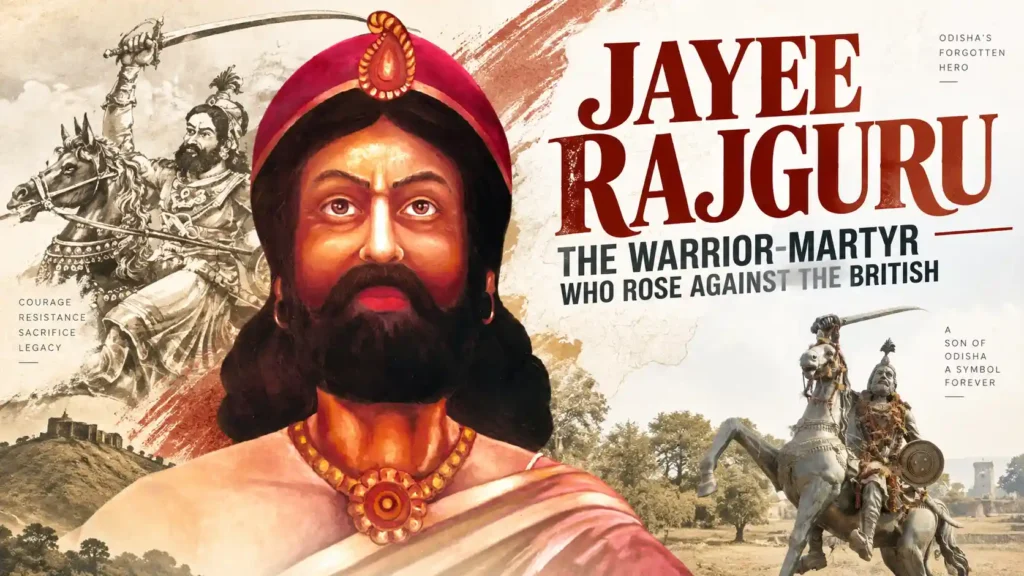
Long before the Revolt of 1857 became a defining chapter in India's freedom struggle, Odisha had already witnessed a powerful armed resistance against British colonial expansion. At the centre of this early resistance was Jaykrushna Rajguru Mohapatra, popularly known as Jayee Rajguru.
A scholar, royal preceptor, administrator and military commander, Jayee Rajguru played a leading role in the Khurda Rising of 1804, mobilising the traditional Paika forces against the British East India Company.
For me, his story became much more personal when I visited Biraharekrushnapur, his ancestral village near Puri. Standing in the village associated with a man who sacrificed his life for his land made the history feel far more real than reading about it in a book. You can also read about the later Paika Rebellion and how it became another important chapter in Odisha's resistance against British rule.Table of Contents
Who Was Jayee Rajguru?
Jayee Rajguru's full name was Jaykrushna Rajguru Mahapatra.
He was born on October 29, 1739, in Biraharekrushnapur, near Puri, Odisha, into a family of eminent Sanskrit scholars.
He became:
- Rajguru (Royal Preceptor)
- Mukhyamantri (Chief Minister)
- Commander-in-Chief of Khurda
- Strategist and organiser of the traditional Paika forces
His life combined scholarship, administration and military leadership at a crucial period in Odisha's history.
What Was Jayee Rajguru's Role in the Khurda Resistance?
After the British East India Company took control of coastal Odisha in 1803, the Kingdom of Khurda came under increasing pressure.
The British sought submission from the Khurda kingdom, including demands relating to taxes and control over the strategic Purushottam Kshetra (Puri).
Jayee Rajguru recognised the threat posed by British expansion and refused to accept their terms.
He began organising resistance by bringing together:
- Paika warriors
- Village chieftains or Dalbeheras
- Mountain tribes
- Local forces across Khurda
The traditional Paikas were not simply soldiers. They were Odisha's landed militia, closely connected with the social and political structure of the region.
How Did Jayee Rajguru Organise the Paikas?
Jayee Rajguru used his administrative and military experience to strengthen Khurda's defence.
He reorganised the revenue system, strengthened strategic positions and helped turn local Paikas into a disciplined fighting force.
When British troops advanced towards Khurda in 1804, his forces adopted guerrilla tactics.
The forests and terrain around Barunei Hill became important defensive positions. Rajguru's forces attacked British columns, disrupted their supply routes and resisted their advance between Cuttack and Puri.
What Happened at Barunei Fort?
One of the important episodes of the resistance was the Siege of Barunei Fort.
For approximately three weeks, Jayee Rajguru and his warriors defended the foothills of Barunei against British forces equipped with superior artillery.
Eventually, internal betrayal combined with the British military advantage led to the fall of the fort.
The resistance, however, had already established Jayee Rajguru as one of the earliest prominent leaders of armed resistance against British rule in Odisha.
Why Did Jayee Rajguru Surrender?
Jayee Rajguru eventually surrendered to the British to prevent the complete destruction of Khurda and to protect the young king, Mukunda Deva II.
He was arrested and taken through the British judicial process, first at their military headquarters in Cuttack and later to Midnapore.
During his trial, he refused to seek mercy or accept British sovereignty.
According to the account provided, he accepted responsibility for declaring war against the East India Company in defence of his motherland.
How Did Jayee Rajguru Die?
The story of Jayee Rajguru's death remains one of the most tragic episodes in Odisha's early freedom struggle.
On December 6, 1806, at Baghitota in Midnapore, the British executed him in a brutally violent manner.
His legs were tied to the bent branches of two separate banyan trees. When the branches were released, his body was torn apart.
His martyrdom became a powerful symbol of resistance in Odisha and helped create the revolutionary atmosphere that later contributed to the Paika Rebellion of 1817, led by Bakshi Jagabandhu.
My Visit to Biraharekrushnapur: Walking Through Jayee Rajguru's Village
One of the most meaningful parts of learning about Jayee Rajguru Odisha is visiting the place where his story began.
I visited Biraharekrushnapur, his ancestral village near Puri. Located roughly 10 km from Puri along the Bhubaneswar–Puri highway, the village carries an important connection to Odisha's freedom history.
Walking through a village associated with such a significant historical figure gave me a different perspective on his life.
We often encounter historical personalities through textbooks, statues and commemorative events. But visiting their birthplace or ancestral home creates a sense of connection that is difficult to experience otherwise.
At Biraharekrushnapur, the ancestral residence has been preserved as a historical memorial, with village archives, statues and traditional artefacts associated with his family lineage.
For me, the visit was not merely about seeing a heritage site. It was about understanding the roots of a man whose life moved from Sanskrit scholarship and royal service to armed resistance and ultimately martyrdom.
When Is Jayee Rajguru Remembered?
Two important dates associated with Jayee Rajguru are:
October 29 – His birth anniversary
December 6 – His martyrdom day
The village is commemorated on these occasions, attracting locals, historians and visitors who come to pay homage.
Why Is Jayee Rajguru Important in Odisha's History?
Jayee Rajguru represents an early phase of organised resistance against British colonial power in eastern India.
His importance lies not only in the battle he fought but also in the way he brought together administration, military strategy and local resistance.
His story also provides an important context for understanding the later Paika Rebellion of 1817.
The resistance of 1804 and the subsequent events demonstrate that opposition to British colonial rule in Odisha began much earlier than the better-known national events of the mid-19th century.
What Can We Learn from Jayee Rajguru's Life?
His story offers several enduring lessons:
- Courage: He refused to surrender his principles despite overwhelming odds.
- Leadership: He united different sections of society against a common threat.
- Scholarship and action: His intellectual training existed alongside military and administrative abilities.
- Sacrifice: He accepted personal suffering to protect Khurda and its young king.
- Love for the motherland: His resistance was rooted in the defence of his kingdom and homeland.
Frequently Asked Questions About Jayee Rajguru
Who was Jayee Rajguru?
Jayee Rajguru, whose full name was Jaykrushna Rajguru Mahapatra, was the Rajguru, Chief Minister and military commander of the Khurda Kingdom. He led resistance against the British during the Khurda Rising of 1804.
When was Jayee Rajguru born?
He was born on October 29, 1739, at Biraharekrushnapur near Puri, Odisha.
What was Jayee Rajguru's connection with the Paikas?
He organised and strengthened the traditional Paika militia of Khurda, bringing local warriors and village leaders together to resist British expansion.
When did Jayee Rajguru die?
Jayee Rajguru was executed on December 6, 1806, at Baghitota in Midnapore.
Where was Jayee Rajguru born?
His ancestral village and birthplace was Biraharekrushnapur, near Puri in Odisha.
Was Jayee Rajguru connected with the Paika Rebellion?
Yes. His resistance during the Khurda Rising of 1804 preceded the much larger Paika Rebellion of 1817, led by Bakshi Jagabandhu.
Key Takeaway
The story of Jayee Rajguru is not simply a story of a warrior. He was a scholar, administrator, royal adviser and military strategist who stood against British expansion at a time when the colonial power was rapidly consolidating its control over Odisha.
And for me, visiting Biraharekrushnapur added another dimension to that history. Seeing the place connected to his early life made me realise that heritage is not confined to monuments and museums, it also lives in villages, memories and the stories passed from one generation to another.
About the Author

Jyotsna Mohapatra
Trending Posts