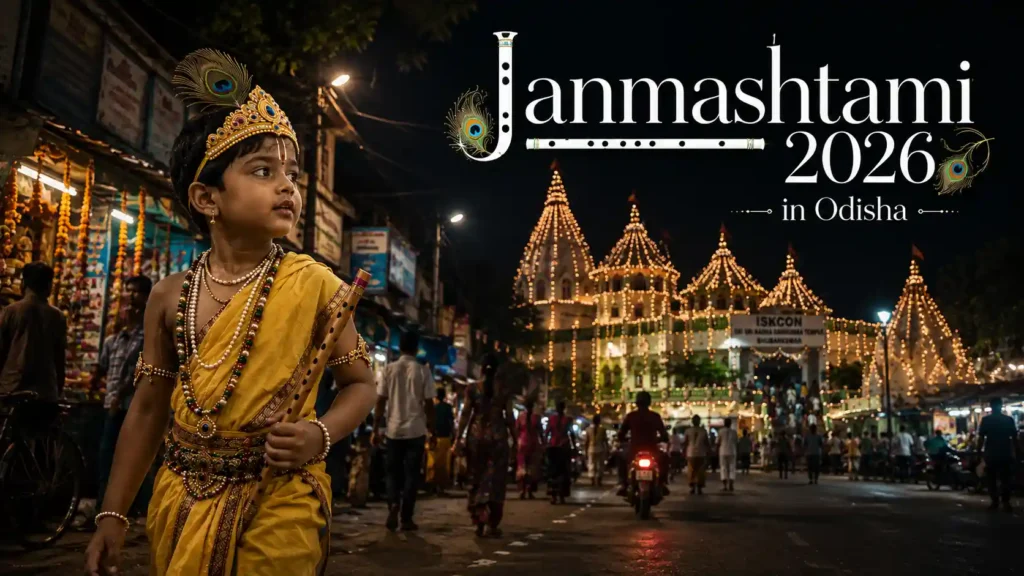
Janmashtami 2026 falls on Friday, September 4. The Government of Odisha lists Janmasthami as a holiday on that date.
For a large organised Krishna celebration in Odisha, ISKCON Bhubaneswar is one of the clearest places to look this year; its official festival calendar lists Janmashtami for September 4, followed by Nandotsava on September 5.
But when I think about Janmashtami, I don’t first think about a big temple programme.
I think about school.
And a Krishna dress.Table of Contents
| Janmashtami 2026 | Details |
|---|---|
| Date | Friday, September 4, 2026 |
| What is celebrated | The birth of Lord Krishna |
| Main religious observance | Krishna’s birth is traditionally marked around midnight |
| A major organised celebration in Odisha | ISKCON Bhubaneswar |
| ISKCON Bhubaneswar’s next-day celebration | Nandotsava — September 5, 2026 |
| For the Jagannath tradition | Puri, but its temple rituals should be understood within the specific Jagannath tradition rather than treated as a generic Janmashtami programme |
| What children often bring to the festival | Krishna and Radharani costumes, school programmes and community celebrations |
| If you plan to attend | Check the particular temple or organisation’s programme before going |
I remember Janmashtami from a Krishna dress
When I was a child in Odisha, Janmashtami meant dressing up as Krishna at school.
That is the memory that comes back first.
Wearing the Krishna costume and going to school like that is what I remember. Sitting there as a child trying to understand the religious calendar or wondering exactly why the festival was celebrated at midnight is not part of the memory.
The dress mattered more to me then.
And then there was the market.
After the school celebration, I would go around the market still wearing the Krishna costume.
That is probably the odd little detail that stayed with me all these years.
The market was still the market. People were doing their usual work. Shops were open. Life was going on normally. I was the one who looked different because I was walking around dressed as Krishna.
There was no particular thought behind it then.
The memory is clearer now.
That is how Janmashtami first became real to me.
Not through a long explanation of Krishna’s life, but through a school costume and an ordinary market.
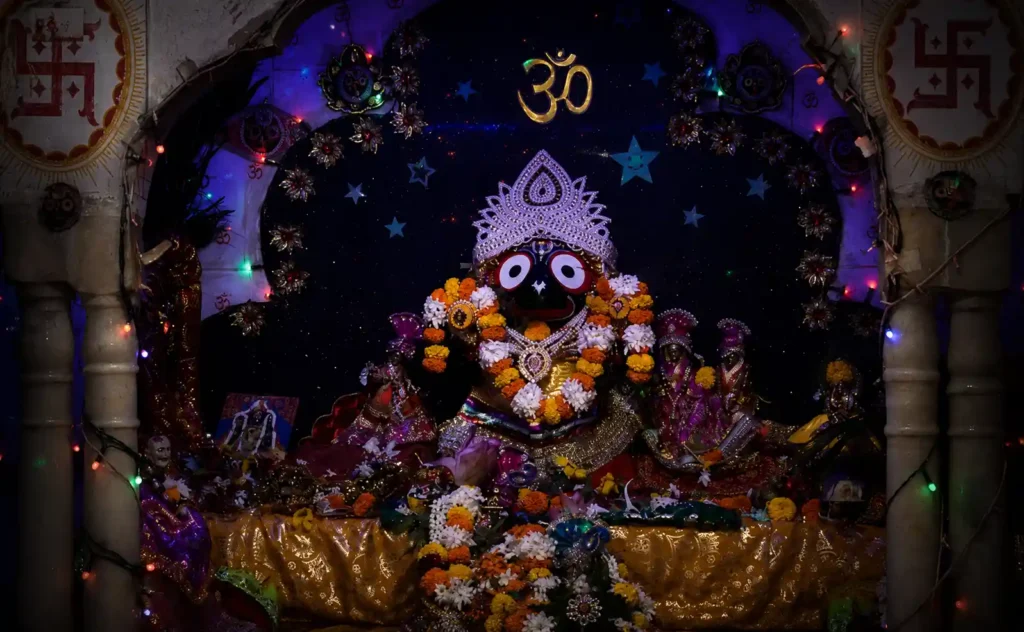
When is Janmashtami in 2026?
For Odisha, Janmashtami is on September 4, 2026. The Government of Odisha’s official holiday listing gives September 4 as Janmasthami.
Some calendars give detailed tithi and Nishita timings that extend past midnight into September 5. For Cuttack, for example, one panchang source lists Nishita Puja from 11:22 PM to 12:09 AM, with Ashtami tithi ending at 12:13 AM on September 5.
For an ordinary reader, though, the important date is simple:
Friday, September 4, 2026.
If you’re planning to attend a particular temple, don’t rely only on the festival date. Check that temple’s own programme.Why is Krishna's birth celebrated at midnight?
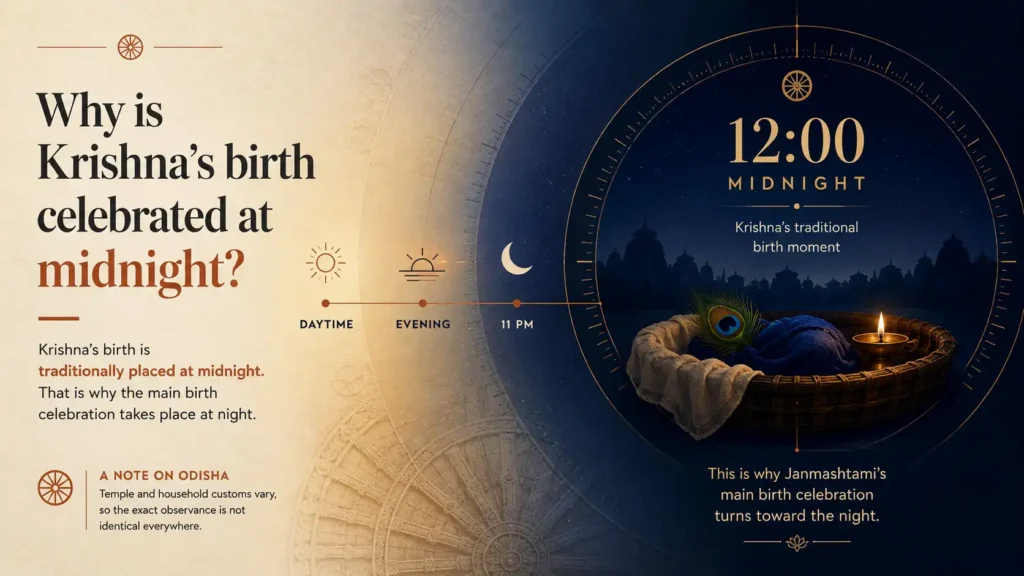
The traditional account places Krishna’s birth at midnight, which is why the main birth celebration is associated with the night rather than with the middle of the day.
That is also why Janmashtami can feel different from many other festivals.
The day may begin quietly.
People may fast or prepare for worship.
There can be bhajan, kirtan and prayers.
Then the focus moves towards the midnight birth celebration. The exact customs are not identical in every household or temple, so I would not use one generic list of rituals and claim that it represents all of Odisha. Odisha has its own temple traditions and local ways of observing festivals.Where is a good place to celebrate Janmashtami in Odisha?
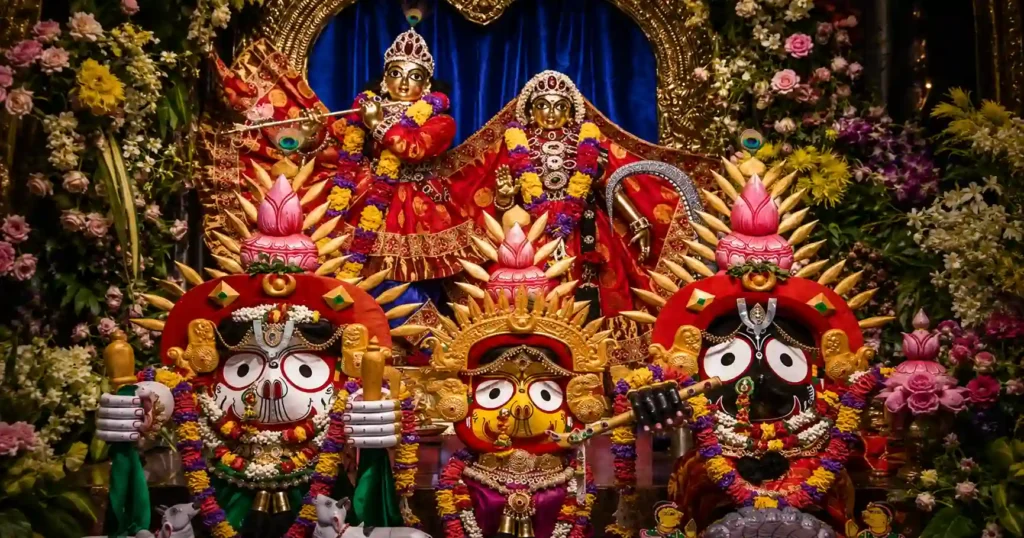
If you want a large, organised Krishna celebration rather than a small family or school programme, ISKCON Bhubaneswar is a practical choice to look at for 2026.
Its official website lists Janmastami on September 4, 2026, and Nandotsava on September 5.
I would put it this way rather than saying Bhubaneswar is simply “the best place.” “Best” depends on what you want.
| What you want to see | Place to consider | What the celebration is about |
|---|---|---|
| A large organised Krishna festival | ISKCON Bhubaneswar | Krishna Janmashtami, followed by Nandotsava the next day |
| Janmashtami within Odisha’s Jagannath religious setting | Puri | The festival sits within the wider religious world of Sri Jagannath Temple |
| A childhood-style celebration | Schools, neighbourhoods and local temples | Krishna costumes, children’s programmes and community worship |
| A home-based celebration | Homes across Odisha | Prayer, fasting where observed, Krishna worship and the midnight birth celebration |
| What you want | Place & celebration |
|---|---|
| A large organised Krishna festival | ISKCON Bhubaneswar Krishna Janmashtami, followed by Nandotsava the next day |
| Janmashtami within Odisha’s Jagannath religious setting | Puri The festival sits within the wider religious world of Sri Jagannath Temple |
| A childhood-style celebration | Schools, neighbourhoods and local temples Krishna costumes, children’s programmes and community worship |
| A home-based celebration | Homes across Odisha Prayer, fasting where observed, Krishna worship and the midnight birth celebration |
Janmashtami and Puri need a little care
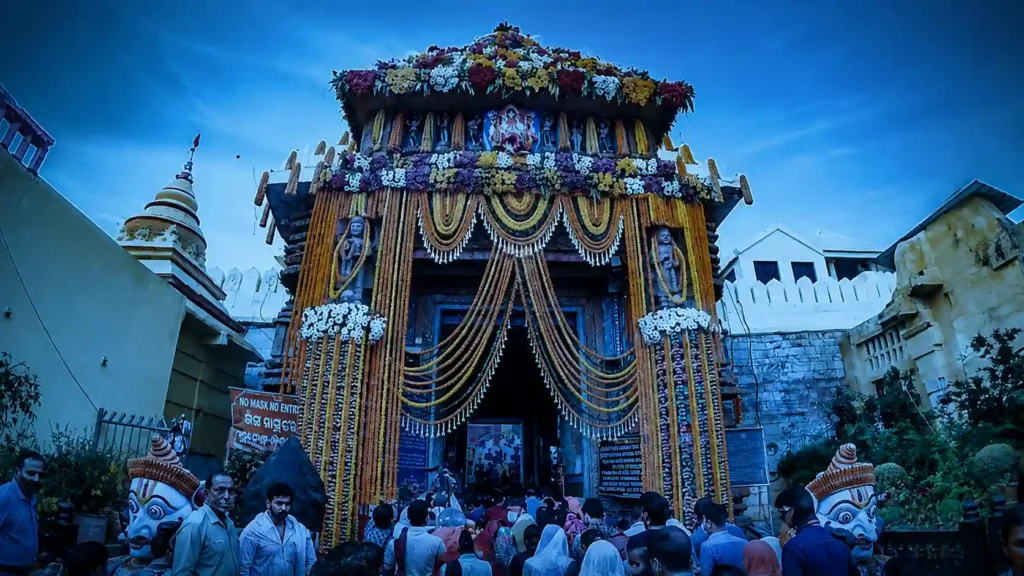
Puri appears in almost every discussion of Odisha's religious festivals, so it is tempting to put it into every festival article as the automatic answer.
I don't think that is good editorial practice.
The Jagannath Temple is a 12th-century temple and the centre of the Jagannath tradition in Puri.
But Janmashtami should not be described there as though Puri simply follows a standard Krishna-temple programme from somewhere else.
The Jagannath tradition has its own ritual vocabulary and calendar.
That matters.
If the article is about Janmashtami generally, Puri can be part of the cultural context. If the article is claiming a particular ritual happens inside Srimandir, that specific claim should be checked against the temple's own documentation.
I would rather leave out a detail than put the wrong ritual into a Puri temple article just because it sounds appropriate.The festival is also visible outside temples
This is probably the part I relate to most.
Janmashtami can appear in a school corridor as easily as it can appear in a temple.
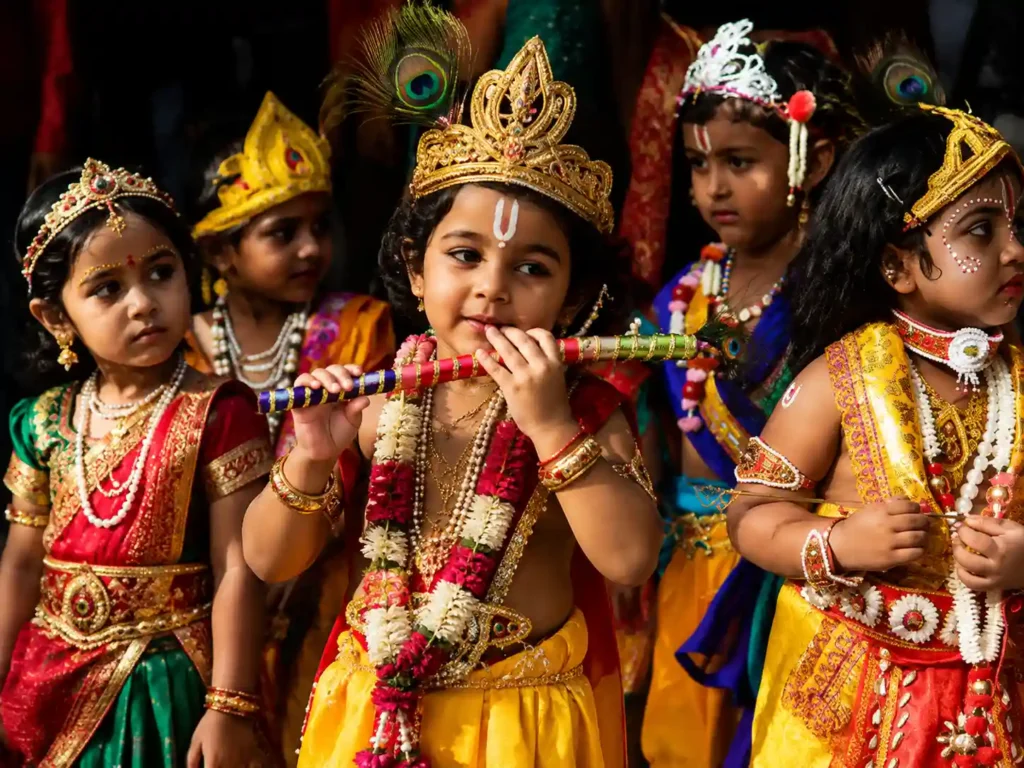
A child wears Krishna's clothes.
Another child may come dressed as Radharani.
There may be a small programme.
Parents are involved.
Teachers organise things.
And then everyone goes home.
That sounds ordinary.
It is ordinary.
But ordinary is exactly why the memory lasts.
My own memory isn't of standing in front of some enormous religious spectacle. It is of being a schoolchild in Odisha, dressed as Krishna, and then going through the market in the same outfit.
I don't need to add a dramatic story to it.
That was the experience.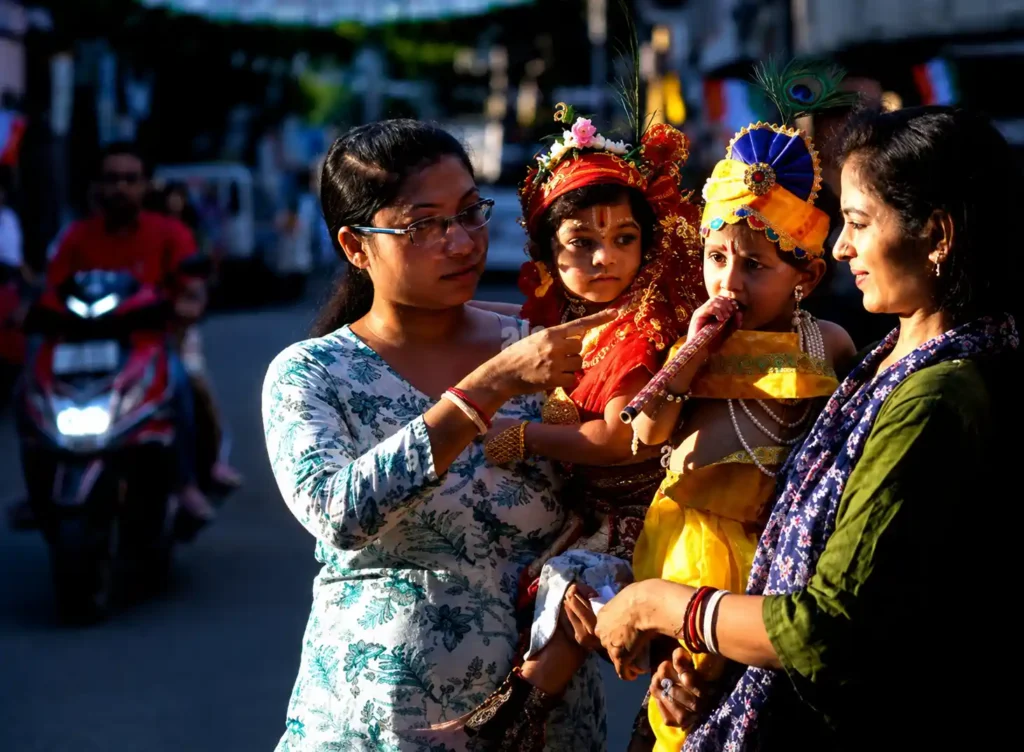
What do people usually do on Janmashtami?
The details depend on the family or religious tradition.
Common observances can include fasting, prayer, bhajan, kirtan, Krishna worship and waiting for the midnight birth celebration.
In Vaishnava celebrations, the focus may be much more elaborate, with organised devotional programmes and a large gathering of devotees.
ISKCON Bhubaneswar's own 2026 festival calendar places Janmashtami on September 4 and Nandotsava on September 5.
For a family celebration, the scale may be completely different.
Someone may simply keep a small Krishna image or idol at home, prepare offerings and observe the midnight worship.
There isn't a requirement that every Janmashtami in Odisha should look like a major public event.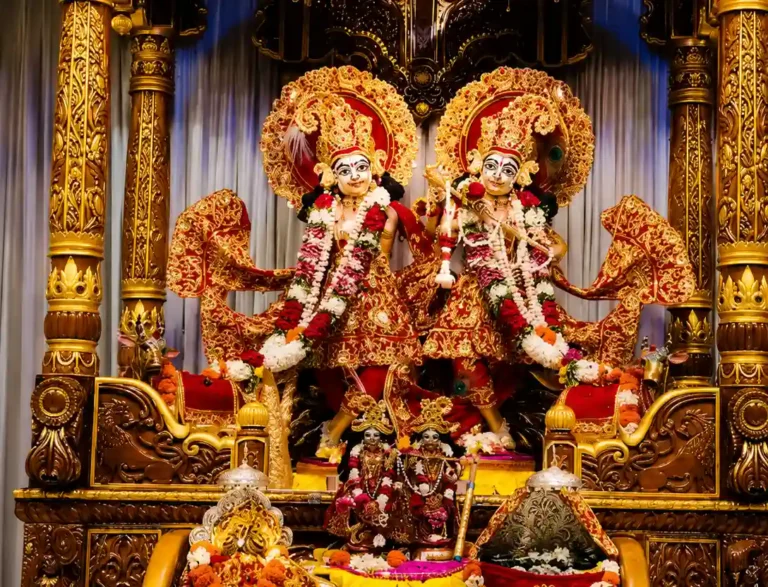
What is Nandotsava?
At ISKCON Bhubaneswar, the festival calendar lists Nandotsava on September 5, 2026, the day after Janmashtami.
Nandotsava is associated with the celebration following Krishna's birth.
So if someone is planning around the ISKCON Bhubaneswar programme, the two dates are worth remembering:
September 4 — Janmashtami
September 5 — Nandotsava
That gives the celebration a continuation rather than making September 4 the only day of interest.What I didn't understand about Janmashtami as a child
I didn't understand the midnight part.
The religious calendar made even less sense to me.
Why Krishna's birth was being celebrated in such a particular way was something I didn't know either.
All I knew was that school was different that day.
And, of course, I knew I was wearing a Krishna dress.
Looking back, that is probably a more honest childhood memory than trying to say I understood the deeper meaning of the festival at the time.
I didn't understand it then.
I was a child.
The understanding came later.
The memory came first.Why I kept thinking about that market
The market part is what makes the memory different for me.
School was expected to have a celebration.
The market wasn't.
Still wearing the Krishna costume, I walked through the market among people who were simply carrying on with their day.
That contrast is what I remember.
A festival had followed me out of school and into an ordinary part of everyday Odisha.
There was no special destination and no grand event to attend.
I was just a child in a Krishna dress walking around the market.
Years later, that is still the picture that comes to mind when I hear Janmashtami.Janmashtami 2026: the useful details
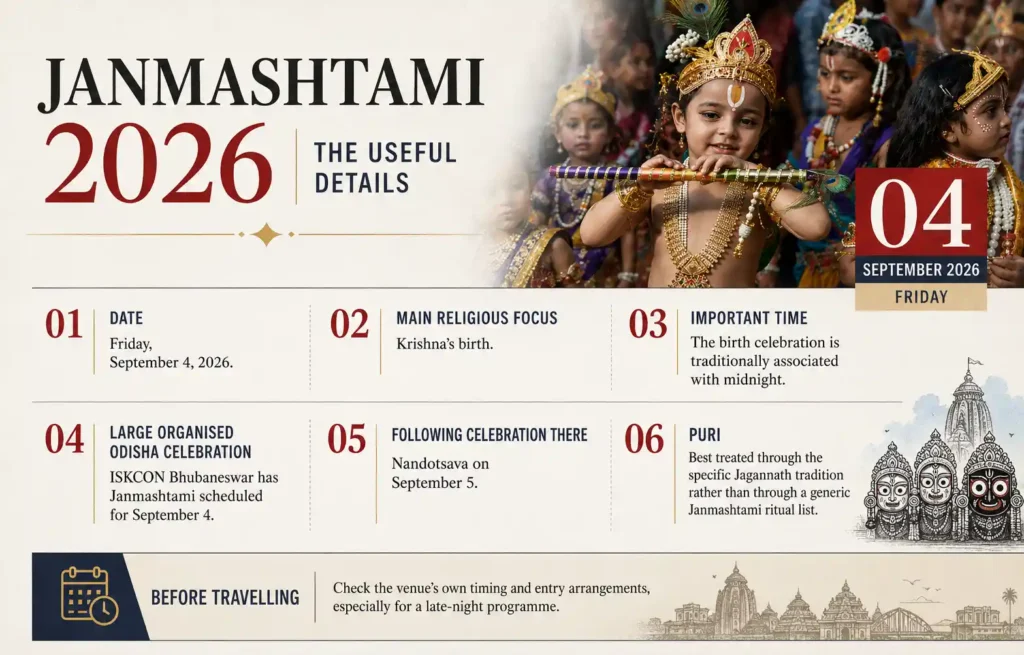
Date: Friday, September 4, 2026.
Main religious focus: Krishna's birth.
Important time: The birth celebration is traditionally associated with midnight.
Large organised Odisha celebration: ISKCON Bhubaneswar has Janmashtami scheduled for September 4.
Following celebration there: Nandotsava on September 5.
Puri: Best treated through the specific Jagannath tradition rather than through a generic Janmashtami ritual list.
Before travelling: Check the venue's own timing and entry arrangements, especially for a late-night programme.Conclusion
I know more about Janmashtami now. I know the date, I understand why the midnight celebration matters, and I know that the festival can look different in a home, a school, a neighbourhood or a temple.
But my first memory of it is still much simpler.
I was a schoolchild in Odisha, dressed as Krishna, and later walking around the market in the same dress. I wasn’t thinking about how I would remember that day years later. At that age, it was just part of the fun.
That little memory has stayed with me.
Maybe that’s what festivals become as we grow older. We learn the stories and understand the rituals, but sometimes one ordinary moment from childhood remains stronger than all the explanations. For me, Janmashtami still begins with that Krishna dress and a walk through the market.About The Author

Jyotsna Mohapatra
Trending Posts