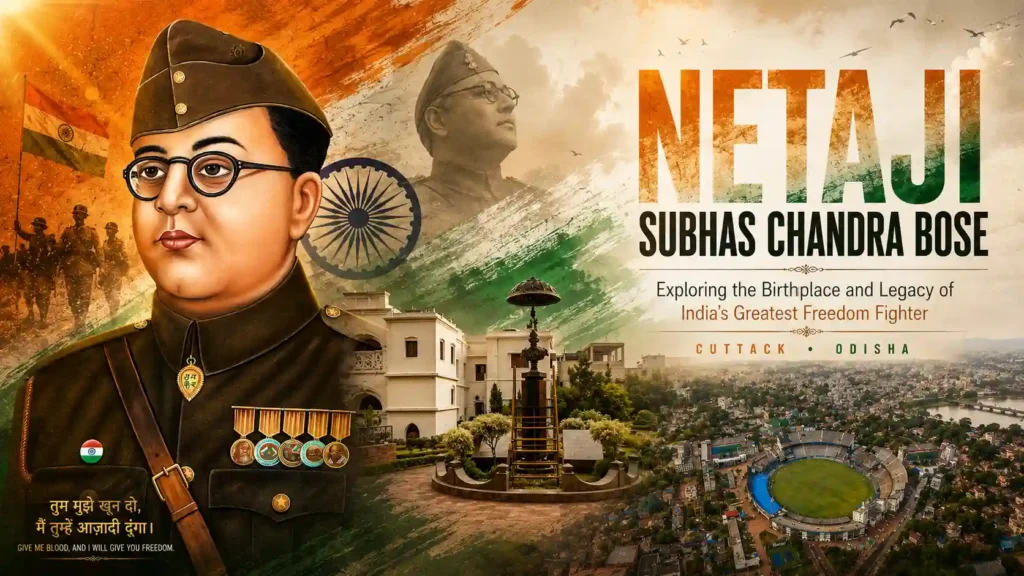
Whenever India remembers its greatest freedom fighters, one name stands tall, Netaji Subhas Chandra Bose.
A fearless patriot, visionary leader, and brilliant strategist, Netaji believed that freedom could never be begged for, it had to be earned through courage and sacrifice.
His immortal slogan,
“Give me blood, and I will give you freedom.”
continues to inspire generations of Indians.
But before he became the legendary commander of the Indian National Army (Azad Hind Fauj), he was a young boy growing up in the historic city of Cuttack, Odisha.
This blog explores the extraordinary life of Netaji, his deep connection with Odisha, and why his legacy remains relevant even today.Table of Contents
Quick Facts About Netaji Subhas Chandra Bose
| Feature | Details |
|---|---|
| Full Name | Netaji Subhas Chandra Bose |
| Date of Birth | 23 January 1897 |
| Birthplace | Janakinath Bhawan, Oriya Bazar, Cuttack, Odisha |
| Parents | Janakinath Bose and Prabhabati Devi |
| Major Organizations | Indian National Congress, Forward Bloc, Azad Hind Fauj |
| Famous Slogan | “Give me blood, and I will give you freedom.” |
| National Commemoration | Parakram Diwas (23 January) |
Why is Netaji Subhas Chandra Bose Famous?
Netaji was one of India’s most influential freedom fighters.
Unlike many leaders who preferred negotiations, he believed that British rule could only end through determined resistance.
His leadership qualities included:
- Extraordinary courage
- Strong patriotism
- Military strategy
- Diplomatic skills
- Commitment to social equality
- Unwavering belief in complete independence
Even today, millions regard him as one of the greatest nationalist leaders in Indian history.
Why is Cuttack Important in Netaji's Life?
For the people of Odisha, Netaji is more than a national hero.
He is one of their own.
Netaji was born on 23 January 1897 at Janakinath Bhawan in Oriya Bazar, Cuttack, into the family of eminent lawyer Janakinath Bose and Prabhabati Devi.
His early years in Cuttack shaped his personality, values, and love for the nation.
Where Did Netaji Study?
Netaji completed his early education in Cuttack.
He studied at:
- Protestant European School
- Ravenshaw Collegiate School
One of the greatest influences on his life was his headmaster Beni Madhav Das, who inspired him to serve humanity and dedicate his life to the nation.
These formative years laid the foundation for the fearless leader he would later become.
Visit the Netaji Birth Place Museum in Cuttack
One of Odisha’s most important heritage attractions is the Netaji Birth Place Museum.
The ancestral home of Netaji has been carefully preserved as a museum for visitors.
Inside the museum, you can explore:
- Fifteen themed galleries
- Rare handwritten letters
- Family photographs
- Personal belongings
- Horse carriage
- Library collection
- Historical documents
The museum offers a fascinating glimpse into the life of one of India’s greatest freedom fighters.
Travel Tip: If you are visiting Cuttack, set aside at least one to two hours to explore the museum and understand Netaji’s remarkable journey.
A Brilliant Student Who Chose the Nation
Netaji was an exceptional scholar.
To fulfil his father’s wish, he travelled to England and appeared for the prestigious Indian Civil Services (ICS) examination.
In 1920, he secured the 4th rank, an achievement that very few Indians had accomplished at the time.
However, serving under British rule conflicted with his patriotic ideals.
In 1921, he resigned from the ICS, one of the boldest decisions in India’s freedom movement, and returned home to dedicate his life to India’s independence.
Major Milestones in Netaji's Journey
1921 – Resignation from ICS
After returning from England, Netaji joined the freedom movement under the guidance of Deshbandhu Chittaranjan Das.
1938 – President of the Indian National Congress
At the Haripur Session, he became President of the Indian National Congress.
He strongly advocated:
- Industrial development
- Scientific planning
- National economic growth
His vision was far ahead of its time.
1939 – Formation of the Forward Bloc
Due to ideological differences over the pace and methods of the freedom struggle, Netaji resigned from the Congress leadership and founded the All India Forward Bloc.
The party aimed to unite patriotic forces for complete independence.
1941 – The Great Escape
Placed under house arrest by the British in Calcutta, Netaji made a daring escape in disguise.
Travelling through Afghanistan and the Soviet Union, he eventually reached Germany before continuing his mission in Southeast Asia.
This remains one of the most dramatic episodes in India’s freedom movement.
The Azad Hind Fauj: A New Chapter in India's Freedom Struggle
Recognising the opportunities created by the Second World War, Netaji reorganised the Indian National Army (INA) in Singapore in 1943.
The INA consisted of:
- Indian prisoners of war
- Overseas Indians
- Patriotic volunteers
Their goal was simple—fight alongside the Allies’ enemies to liberate India from British rule.
The Provisional Government of Free India
On 21 October 1943, Netaji established the Provisional Government of Free India (Azad Hind Government) in Singapore.
The government introduced:
- Its own currency
- Postal stamps
- Passports
- Administrative structure
It also received diplomatic recognition from nine countries.
This marked one of the most remarkable achievements of India’s freedom movement.
The Historic Rani of Jhansi Regiment
One of Netaji’s greatest contributions was empowering women in military service.
He established the Rani of Jhansi Regiment, one of the world’s earliest all-women combat units in a modern military force.
Led by Captain Lakshmi Swaminathan, the regiment became a symbol of courage, equality, and patriotism.
The INA's Campaign
Under Netaji’s leadership, the Indian National Army advanced towards India’s eastern frontier.
Major achievements included:
- Liberation of the Andaman and Nicobar Islands
- Renaming them as Shaheed and Swaraj Islands
- Advancing into parts of Manipur and Nagaland
Although military progress later slowed due to difficult monsoon conditions and supply shortages, the campaign inspired millions across India.
Why is Netaji Still Relevant Today?
Netaji’s influence extends far beyond the freedom struggle.
His life teaches us the importance of:
- Courage
- Discipline
- Leadership
- Patriotism
- Equality
- National unity
- Self-respect
His dream of an India free from poverty, discrimination, and communal divisions continues to inspire citizens today.
Places to Visit Related to Netaji in Cuttack
If you wish to explore Netaji’s legacy, don’t miss these important heritage sites:
- Netaji Birth Place Museum
- Janakinath Bhawan
- Oriya Bazar
- Ravenshaw Collegiate School
Together, these places tell the story of the boy who grew up to become one of India’s greatest revolutionaries.
Travel Tips for Visitors
Planning to visit Netaji’s birthplace?
Here are a few suggestions:
- Visit during the morning for a relaxed experience.
- Allocate one to two hours for the museum.
- Read the exhibits carefully to appreciate the historical context.
- Combine your visit with nearby heritage attractions in Cuttack, such as the Barabati Fort, Chandi Temple, and the Mahanadi riverfront.
People Also Ask – Answers to Common Questions
1. Who was Netaji Subhas Chandra Bose?
2. Where was Netaji Subhas Chandra Bose born?
3. Why did Netaji resign from the Indian Civil Services?
4. What is the Netaji Birth Place Museum?
5. Why is Parakram Diwas celebrated?
Key Takeaways
- Netaji Subhas Chandra Bose was one of India’s greatest freedom fighters and military leaders.
- His birthplace in Cuttack, Odisha, played a crucial role in shaping his values and patriotism.
- He resigned from the prestigious ICS despite securing the fourth rank to dedicate his life to India’s independence.
- He founded the Forward Bloc, led the Azad Hind Fauj, and established the Provisional Government of Free India.
- The Netaji Birth Place Museum in Cuttack preserves his remarkable legacy for future generations.
- His ideals of courage, discipline, equality, and national unity continue to inspire India.
Conclusion
Trending Posts