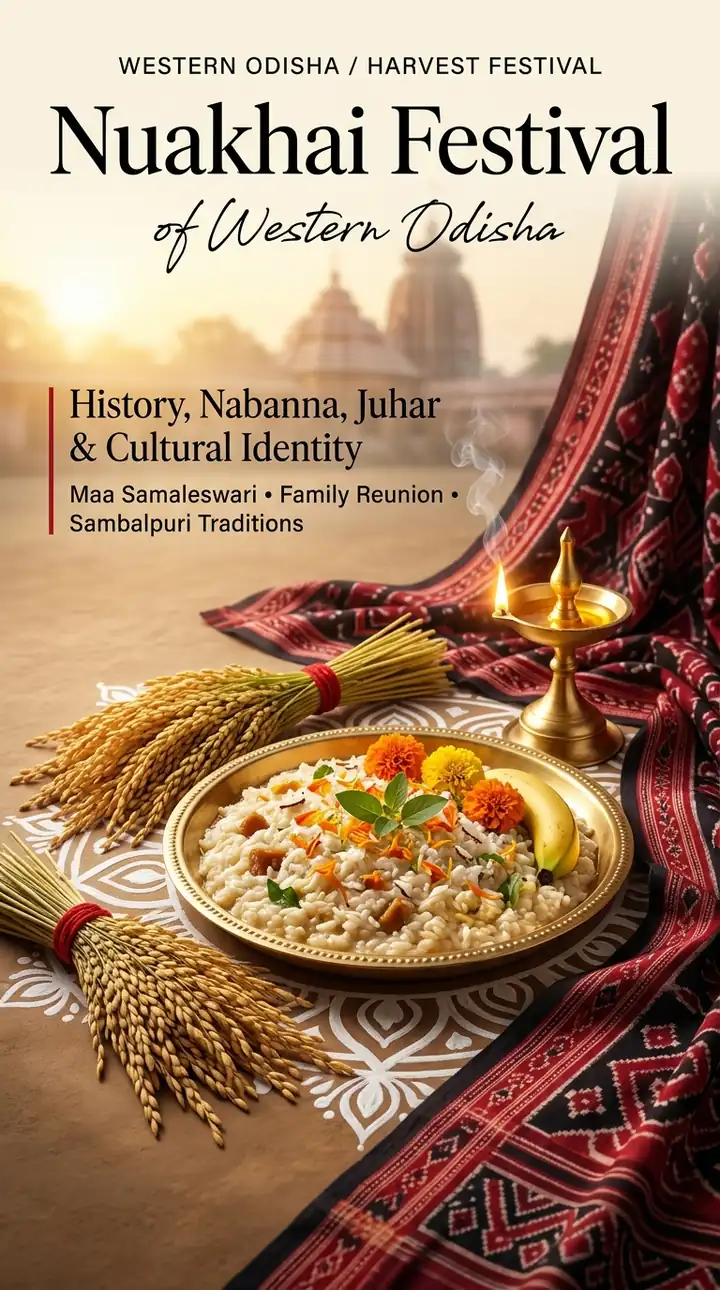
In western Odisha, new rice is not simply cooked because the harvest has arrived.
The first grain has to wait.
Before the family tastes it, the new crop is offered to the deity. Only after that sacred offering does the rice become part of the household meal.
That small act explains Nuakhai better than any grand definition.
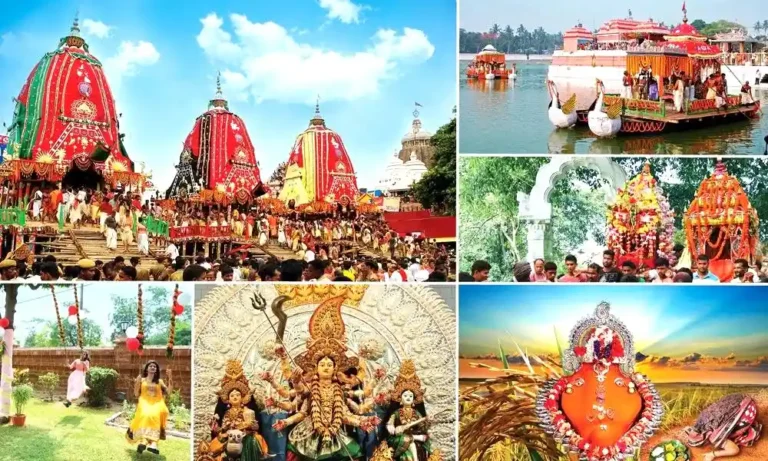
At its core, Nuakhai is about the first eating of the new harvest after offering it to the divine. Over generations, that agricultural ritual grew far beyond the field. It became a family day, a day of Juhar, a day of returning home, a day of folk music, and eventually one of the strongest cultural identities of western Odisha. Alongside celebrations like Raja Parba and Rath Yatra, it stands as one of the cornerstone festivals of Odisha.
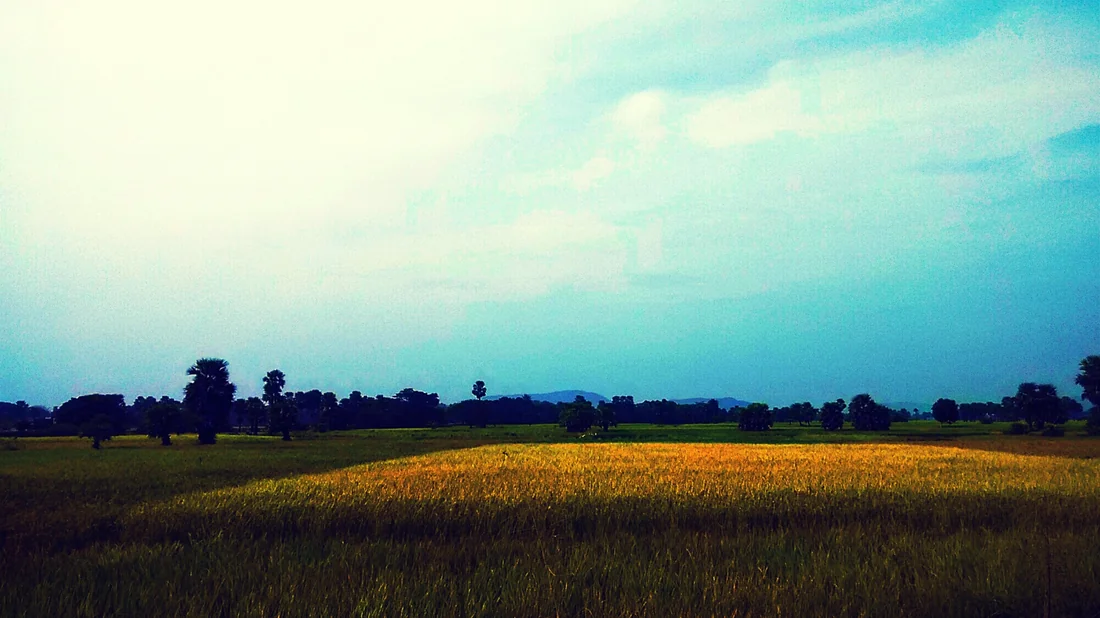
The festival is particularly associated with Sambalpur, Bargarh, Bolangir, Jharsuguda, Sundargarh, Sonepur, Boudh, Nuapada and Kalahandi — the agrarian heartland nourished by the Mahanadi River and Hirakud basin. Academic research on Nuakhai describes how a practice rooted in family and community life gradually became a regional Gana Parva, or mass festival.
And yet, Nuakhai still begins at home.
Why Food Is Sacred in the Nuakhai Tradition
The cultural explanation of Nuakhai begins with anna — food.
In the Sambalpuri oral narration associated with the festival, the idea is expressed through the old philosophical belief that “Anna is Brahma” — food itself is sacred, life-giving and worthy of reverence. This deep spiritual reverence for sustenance is woven into the broader fabric of Odisha Culture and traditions.
The narration connects this understanding with the Bhrigu-Varuna dialogue and also recalls the teaching “Annam na nindyat” — food should not be insulted or treated without respect.
This philosophical language gives Nuakhai a deeper meaning. The new grain is not merely an agricultural commodity. It is treated as the result of land, rain, labour, nature and divine grace.
The academic study reaches the same idea from an anthropological direction. It notes that agricultural communities offer the new crop to the deity as an act of gratitude and also seek blessings for the next harvest.
So Nuakhai is both practical and sacred. The field produces the crop. The ritual gives the crop permission to enter the family meal.
What Does Nuakhai Mean?
The meaning is direct: Nua means new, while Khai refers to eating.
But the phrase does not mean simply eating freshly harvested rice. The ritual matters.
The newly harvested paddy is regarded as sacred and is not consumed until it has first been offered ceremonially to the reigning or household deity. After that offering, the new grain is accepted as prasad and eaten by the family.
That is why Nabanna, or new rice, sits at the centre of the festival. The first mouthful carries memory, agriculture and devotion together.
Is Nuakhai Only a Tribal Festival?
Nuakhai is often described casually as a tribal harvest festival. The research paper complicates that idea.
It records that first-crop and new-rice rituals existed among many tribal groups across central and eastern India, but it also points out that similar practices were present among non-tribal peasant communities.
Different groups had different names for the ritual. The Santals, Oraons, Birjias, Mundas, Kharias and other communities had their own forms of first-crop observance. Similar practices also existed among caste-Hindu agricultural communities.
The paper therefore argues that the more useful question is not “who copied Nuakhai from whom?” The important point is that offering the first crop before eating it was common across communities dependent on land and nature. Over time, these practices were drawn into a larger regional festival identity.
That is a much richer history than assigning Nuakhai to one community alone.
Ramai Dev and the Expansion of Nuakhai
A widely repeated western Odisha tradition associates Ramai Dev of Patnagarh with the expansion of Nuakhai into a larger public festival.
The Sambalpuri narration describes Ramai Dev as giving the agricultural festival renewed importance during the Chauhan period.
The academic paper presents the history more cautiously. According to oral tradition discussed by the researchers, Ramai Dev recognised the role of local peasants and tribal communities while consolidating the Chauhan kingdom. Nuakhai was accepted into the emerging state framework, while Samalei also gained importance as a tutelary deity connected with Chauhan rule.
That political recognition mattered. A household ritual began gaining a wider public frame. But Nuakhai still did not have one common date across western Odisha.
Different Regions, Different Goddesses, Different Lagnas
For generations, different parts of western Odisha observed the new-rice ritual according to the presiding deity of the local region. These revered mother deities hold a central place among the sacred Shakti temples of Odisha:
- Sambalpur: Maa Samaleswari
- Patnagarh / Bolangir: Maa Patneswari
- Sonepur: Maa Sureswari
- Kalahandi: Maa Manikeswari
The academic study supports this pattern and explains that different former states followed different tithis and lagnas fixed by the priests connected with their presiding deities.
This is why Nuakhai was once celebrated on different dates across the region. The shared idea was the same. The ritual calendar was local.
How Nuakhai Got One Common Date
A major change came in 1991.
The study records that under then Chief Minister Biju Patnaik, Bhadraba Sukla Panchami — the day after Ganesh Chaturthi — was adopted as the common Nuakhai date and the occasion was recognised as a state holiday.
The Sambalpuri narration remembers the change in social terms: a festival so deeply connected with western Odisha should bring families and communities together on one day rather than remain divided by different local dates. In Odisha’s sacred calendar, this late-monsoon celebration sets the stage for the auspicious autumn observances of Durga Puja and Kartika Masa.
Since then, Bhadraba Sukla Panchami has become the shared festival day. The lagna for offering Nabanna remains sacred, but the calendar now carries a unified regional identity.
Nuakhai Begins Long Before the Festival Morning
Nuakhai is not prepared in a single day. The academic study records nine stages associated with the festival cycle:
- Beheren: Announcement and gathering connected with the festival calendar.
- Lagnadekha: Fixing the auspicious lagna by priests and astrologers.
- Dakahaka: Formal invitations to family members, relatives and community.
- Saphasutura and Lipapuchha: Thorough cleaning, washing and plastering of the house and surroundings.
- Ghinabika: Buying new clothes, puja items, earthen pots and festival essentials.
- Nuadhankhuja: Finding and harvesting the auspicious first sheaves of the new paddy crop.
- Bali Paka: Sacred preparation and ritual offerings before the altar.
- Nuakhai: Ceremonially offering and eating the new harvest (Nabanna).
- Juhar Bhet: Meeting elders, relatives and neighbours to exchange Nuakhai Juhar and blessings.
Seen this way, Nuakhai is not just a meal. It is a sequence.
What Happens at Maa Samaleswari Temple
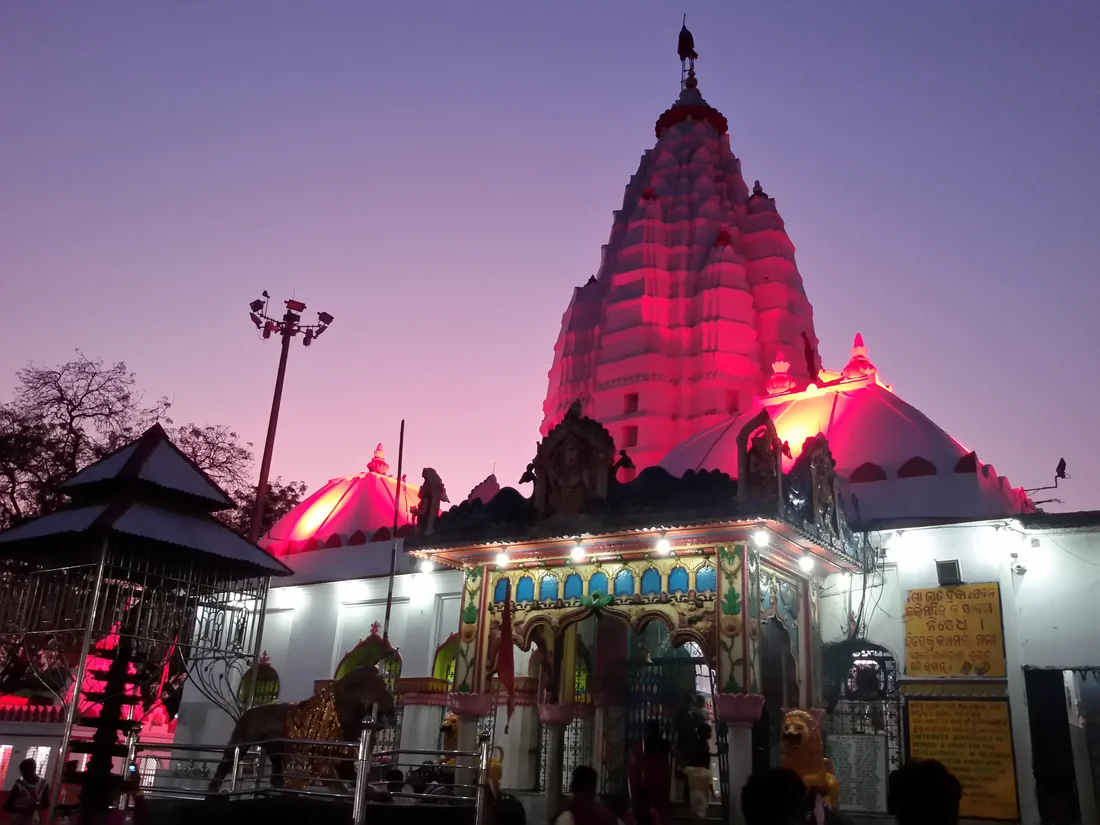
In Sambalpur, the community ritual revolves around Maa Samaleswari.
At the prescribed lagna, the head priest offers the new rice — Nua Anna or Nabanna — to the Goddess. Only after this sacred offering do households proceed with their own Nuakhai ritual.
This timing gives the celebration a remarkable rhythm. Across homes, people wait. The new rice has already been prepared. Family members have gathered. But the first offering belongs to the deity. Once Nabanna is offered, the household ritual can begin.
What Happens at Home on Nuakhai
The house is cleaned before the festival. Families buy new clothes according to their means, often selecting iconic local handwoven textiles highlighted in our guide to the art and crafts of Odisha. Puja materials are arranged. Those living away from home often try to return for the occasion.
Women draw jhuti using rice paste at the entrance and courtyard, decorating the path with motifs of feet, flowers and grain ears.
Then the new crop is offered at home. The academic study records Maa Mahalaxmi as the household deity receiving the offering after the temple Nabanna ritual. Dhupa (incense), deepa (oil lamp), abhishek and naibedya form part of the worship.
The Sambalpuri narration adds another familiar image from western Odisha households: new rice or chura being used to prepare khiri, which is first offered to the family deity.
Different communities also follow their own serving customs. The narration mentions families eating the nua on Mahul leaves or Kure leaves, depending on community practice.
That local variation is important. There is no single household script followed identically everywhere.
What Foods Are Prepared for Nuakhai?
The academic study records several traditional preparations used in the household offering:
- Kheer (Khiri): Prepared with newly harvested paddy rice, milk, cardamom and jaggery or sugar
- Kakara Pitha: Sweet deep-fried semolina or wheat fritters stuffed with coconut and jaggery
- Manda Pitha: Steamed rice-flour dumplings with sweet coconut filling
- Puri: Freshly fried flatbreads offered during naibedya
- Other locally prepared offerings: Seasonal vegetable curries without onion and garlic
The food is not presented as a feast first. It is naibedya first. Only after worship does it become food for the family.
Who Gives the Nua to the Family?
The eldest member has an indispensable role.
The paper records the custom of the senior family member distributing the nua among household members. The family gathers together and consumes the new crop as prasad.
The Sambalpuri narration describes the same practice in familiar terms: the purukha or sian, the senior person of the household, gives nua to the rest of the family.
That moment carries more than ceremonial authority. It connects generations. The harvest is new. The blessing comes from the old.
Nuakhai Juhar: The Part Every Family Understands
After the nua comes Juhar.
The younger members bow before the elders. They may touch their feet or take pahadhuel, the symbolic dust or blessing from the feet of elders. The elders bless them in return.
The research paper describes Nuakhai Juhar as a practice that strengthens solidarity and provides an occasion to put aside differences and renew relationships.
The Sambalpuri narration says it more emotionally: anger, ego, resentment and jealousy are supposed to be left behind. People meet again. A younger person bows. An elder blesses.
For many families, this is the real emotional centre of Nuakhai.
Nuakhai in the Village: Gramdevi and Khet Puja
Village Nuakhai carries its own rhythm.
The Jhankar or village priest distributes bundles of new paddy to households before the festival. On Nuakhai morning, the Jhankar performs Nabanna puja before the Gramdevi (village presiding goddess).
Farmers also go to their fields and perform Khet Puja, worshipping Mother Earth (Dharitri Mata). The study records offerings of water, incense, lamp and bhoga, followed by handfuls of rice offered to the earth. Milk may also be poured on the fertile land with a heartfelt prayer for a bountiful future harvest.
This scene brings the festival back to its agricultural root. Before the celebration reaches the stage, dance floor or Bhetghat, it returns to the field.
The Bolangir Tradition: Paahur Jatra and Churaakuna
Nuakhai is regional, but its rituals are not identical everywhere.
The study records a particularly interesting tradition from Bolangir. On the evening before Nuakhai, a procession called Paahur Jatra carries worship materials and bunches of Nabanna to temples. A new Chhatar, or ceremonial umbrella, is also offered.
The procession symbolically invites the deities for the coming Nabanna ritual.
The following morning, new grain is fried in a new earthen pot. It is then pounded into chura. Ghee and honey are mixed with it to prepare Churaakuna.
The preparation is first offered to Maa Samaleswari and Maa Patneswari before household worship continues.
Details like these are what make Nuakhai a living regional festival rather than a uniform ritual copied from one place to another.
From Family Juhar to Nuakhai Bhetghat
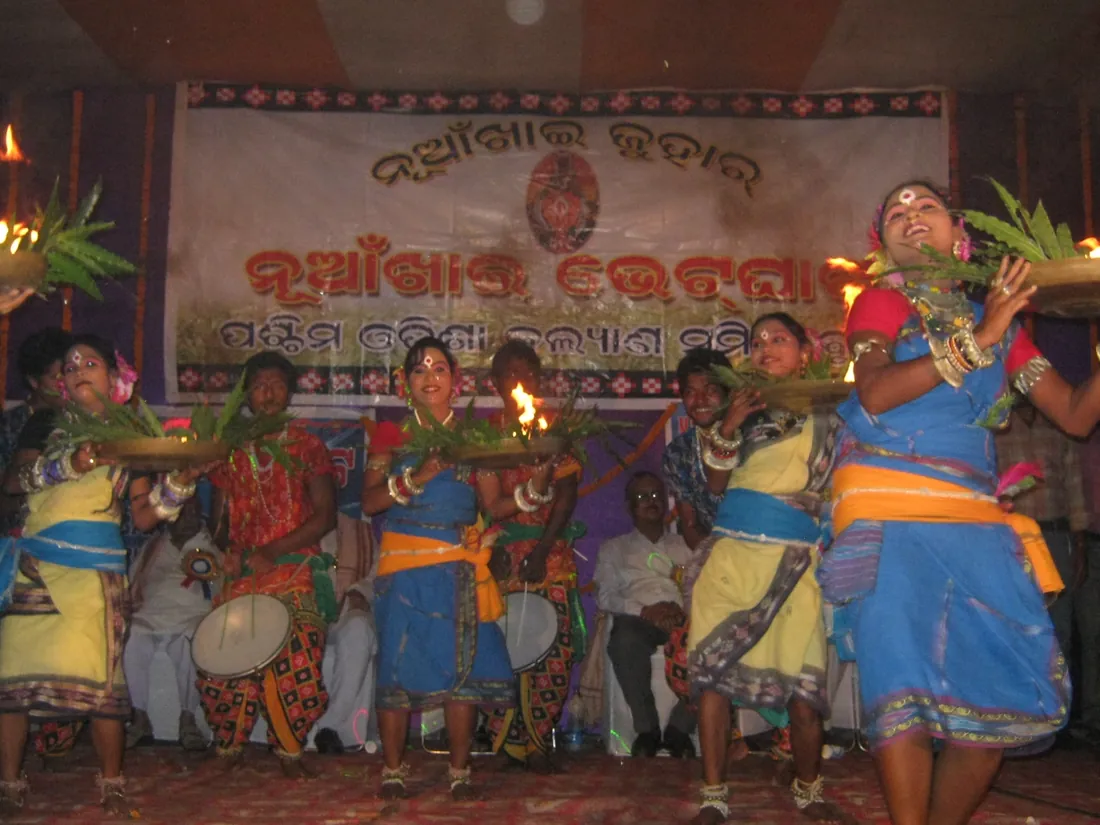
Once the household rituals are over, Nuakhai moves into a wider social space. That is where Nuakhai Bhetghat enters.
Bhetghat means meeting. But over time, it has become much more than a simple gathering.
People sing. People dance. Communities organise cultural programmes. Old friends meet. Artists perform.
The academic study records folk forms such as Rasarkeli, Dalkhai, Maelajada, Nachnia and Bajnia as part of contemporary Bhetghat celebrations.
The Sambalpuri narration also mentions Mailajada, Rasarkeli, Dalkhai and Chutkuchuta.
It adds another cultural detail: senior artists are remembered and honoured during Bhetghat programmes. Living artists may be felicitated with new traditional handloom gamchas and clothes.
This is where Nuakhai moves from harvest ritual into cultural memory.
Nuakhai Is No Longer Limited to Western Odisha
Nuakhai Bhetghat now travels.
People from western Odisha living in other Indian cities — such as Bhubaneswar, Cuttack, New Delhi, Bengaluru, Mumbai, Hyderabad, and Kolkata — organise grand gatherings. Odia diaspora communities in the United States, the UK, the Gulf, and Australia also meet under the Nuakhai banner.
The academic study describes this as one of the ways Nuakhai now connects people living away from the region with their cultural roots.
That is an important shift. The original ritual depends on land and harvest. The modern identity can travel without the field.
Someone living hundreds or thousands of kilometres from Sambalpur may still say “Nuakhai Juhar” and immediately feel the warmth of home.
What Is Nuakhai Basi?
The day after the festival is called Nuakhai Basi.
The academic study describes it as a more relaxed day of enjoyment with relatives and friends, where non-vegetarian feasts, traditional snacks and beverages often form part of the celebration.
After the spiritual discipline of the main ritual day, the following day belongs more fully to leisure and camaraderie. The household has already eaten nua. Juhar has been exchanged. Now the festival breathes.
How Nuakhai Became the Cultural Identity of Western Odisha
This is the larger story behind the festival.
Nuakhai did not become important because every community abandoned its own customs. The opposite happened.
Different communities kept their deities, rituals, food habits and local practices. But they found a shared idea in the first-crop offering.
That shared ritual gradually became larger than any one village, caste, tribe or former kingdom.
The research describes this as a movement from a community-based folk ritual to a regional cultural identity.
That explains why Nuakhai can mean several things at once:
- To a farmer: It is the celebration of the new harvest and fertile land.
- To a family: It is a sacred homecoming and reunion.
- To an elder: It is the heartfelt exchange of Juhar and blessings.
- To a performer: It is Bhetghat, rhythms of Dhol and Nisan, and living folk heritage.
- To someone living outside Odisha: It is the one day of the year when western Odisha feels closest to the heart.
Nuakhai Quick Facts
| Topic | Detail |
|---|---|
| Festival | Nuakhai (The Grand Harvest Festival) |
| Region | Western Odisha (Sambalpur, Bargarh, Bolangir, Kalahandi, Sonepur, Sundargarh, Jharsuguda, Nuapada, Boudh) |
| Core Ritual | Offering newly harvested rice (Nabanna) to the deity before household consumption |
| New Rice Offering | Nabanna / Nua Anna |
| Common Date | Bhadraba Sukla Panchami (fifth day of the bright fortnight of Bhadraba) |
| Calendar Timing | Observed the day after Ganesh Chaturthi |
| Major Deity in Sambalpur | Maa Samaleswari |
| Other Regional Deities | Maa Patneswari (Patnagarh/Bolangir), Maa Sureswari (Sonepur), Maa Manikeswari (Kalahandi) |
| Family Custom | Senior-most member (purukha / sian) distributes nua as prasad |
| Social Custom | Nuakhai Juhar (juniors seek blessings, seniors bless, resolving conflicts) |
| Community Celebration | Nuakhai Bhetghat (gatherings, music, felicitations) |
| Village Ritual | Gramdevi Nabanna puja by Jhankar and Khet Puja in agricultural fields |
| Bolangir Tradition | Paahur Jatra procession, Chhatar offering, and preparation of Churaakuna |
| Popular Folk Forms | Dalkhai, Rasarkeli, Mailajada, Chutkuchuta, Nachnia, Bajnia |
| Day After Nuakhai | Nuakhai Basi (day of leisure, feasting and visiting) |
Conclusion
Nuakhai is easiest to understand through one household scene.
The new grain is ready. The family is together. Nobody eats yet.
First, the crop goes to the deity. Then the elder distributes the nua. The family eats. The younger members bow before the elders. Juhar follows.
Later, drums begin. People meet outside. Dalkhai and Rasarkeli take over the evening.
That sequence has survived while everything around it has changed. Kings disappeared. Old state boundaries disappeared. People moved to Bhubaneswar, Delhi, Bengaluru, Mumbai and countries far from Odisha. Nuakhai moved with them.
What began around the new harvest now holds together something much larger — memory, family, agriculture, devotion and the cultural identity of western Odisha. The research describes that transformation clearly: a community-based folk ritual gradually became a regional Gana Parva and a shared identity beyond individual community boundaries.
Explore More: Odisha Festivals & Cultural Heritage Cluster
Planning to explore more of Odisha’s vibrant traditions, holy shrines, and festive heritage? Dive into our comprehensive pillar guides across LocalDrive:
- Complete Seasonal Festival Guide: Discover the full yearly cycle of celebrations in our pillar guide to Festivals of Odisha: Discover the Most Vibrant Odia Celebrations.
- Living Soul of Utkal: Learn about the history, art forms, and cultural philosophy of the state in Odisha Culture: The Living Soul of Utkal – Art, Traditions, Festivals & Heritage.
- Handloom, Weaving & Folk Dance: Explore Sambalpuri bandha ikat, Pattachitra, and regional music in Art & Crafts of Odisha: Dance, Painting, Handloom & Where to See Them.
- Goddess Shrines & Shakti Peethas: Read our complete pilgrim guide to Maa Samaleswari, Maa Patneswari, and ancient shrines in Shakti Temples of Odisha: Goddess Shrines, Shakti Peethas & Yogini Temples.
- Western Odisha Waters & Dams: Trace the path of the sacred river and the engineering marvel near Sambalpur in Rivers, Lakes & Dams of Odisha: Complete Travel Guide.
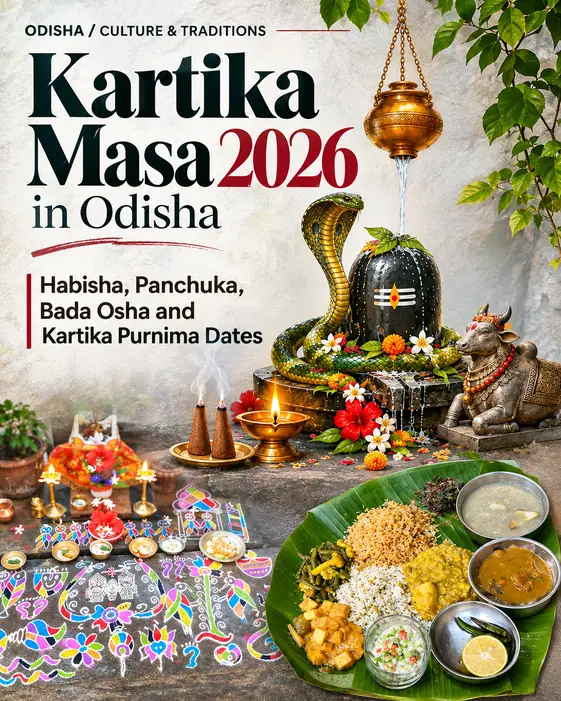
- Austerity & Autumn Feasts: Explore the month-long vows, Habisha rituals, and Kartika Purnima in Kartika Masa in Odisha: Habisha, Panchuka, Bada Osha & Boita Bandana.
Frequently Asked Questions About Nuakhai Festival
What is Nuakhai?
Nuakhai is the major harvest festival of western Odisha in which the newly harvested paddy crop is first offered to the presiding deities and household gods as Nabanna, after which it is consumed with reverence by the family.
What does Nuakhai mean?
The name is derived from two Odia/Sambalpuri words: “Nua” meaning new, and “Khai” meaning eating. It signifies the ceremonial first eating of the season’s new harvest.
Why is new rice offered before eating?
The ritual recognises the divine as the giver and protector of the crop. The offering expresses gratitude for nature’s bounty, acknowledges the hard labour of peasants, and seeks blessings and fertility for the subsequent harvest cycle.
Is Nuakhai only a tribal festival?
No single-origin explanation fully accounts for it. Historical and anthropological studies record identical first-crop ceremonies among both indigenous tribal communities (Santals, Oraons, Mundas, Kharias) and non-tribal peasant communities. Nuakhai represents an amalgamation of these shared agrarian traditions into a unified regional celebration.
Who was Ramai Dev in Nuakhai history?
Oral tradition associates 14th-century Chauhan ruler Ramai Dev of Patnagarh with expanding Nuakhai from a localized peasant ritual into an official state festival, integrating tribal communities and establishing Maa Samaleswari/Patneswari as regional patron deities.
When is Nuakhai celebrated?
Since 1991, Nuakhai is observed uniformly across western Odisha on Bhadraba Sukla Panchami, the fifth day of the waxing moon in the Odia month of Bhadraba (the day after Ganesh Chaturthi).
Which Goddess receives Nabanna in Sambalpur?
In Sambalpur, the ceremonial Nabanna offering is made to presiding deity Maa Samaleswari at a predetermined auspicious lagna fixed by the temple priests.
What is Nuakhai Juhar?
Nuakhai Juhar is the cherished social and family greeting where younger members bow down and touch the feet of elders (pahadhuel), while elders bestow affectionate blessings. It symbolizes humility, generational respect, forgiveness, and the renewal of relationships.
What is Nuakhai Bhetghat?
Nuakhai Bhetghat is the community gathering held on the festival evening and following days, where relatives, neighbours and friends meet, exchange warm greetings, felicitate artists, and celebrate with traditional Sambalpuri music and dance.
What are the nine stages of Nuakhai?
The nine ritual stages are: Beheren (calendar announcement), Lagnadekha (fixing auspicious lagna), Dakahaka (invitations), Saphasutura/Lipapuchha (cleaning the home), Ghinabika (shopping for essentials), Nuadhankhuja (harvesting first paddy ears), Bali Paka (puja preparation), Nuakhai (sacred meal), and Juhar Bhet (exchanging greetings).
What is Paahur Jatra?
Paahur Jatra is a unique Bolangir tradition where a sacred procession carrying bunches of new paddy and a ceremonial umbrella (Chhatar) visits local temples on Nuakhai eve, formally inviting the deities for the Nabanna offering.
What is Churaakuna?
Churaakuna is a traditional preparation popular in Bolangir, made by roasting fresh harvest paddy in a new earthen pot, pounding it into beaten rice (chura), and mixing it with pure ghee and honey before offering it to Maa Samaleswari and Maa Patneswari.
What dances are associated with Nuakhai Bhetghat?
Popular Sambalpuri folk dance forms associated with Bhetghat include Dalkhai, Rasarkeli, Mailajada, Chutkuchuta, Nachnia, and Bajnia, performed to the energetic beats of the Dhol, Nisan, Tasa, and Mahuri.
Why is Nuakhai important outside western Odisha?
Nuakhai Bhetghat serves as an emotional and cultural anchor for western Odia communities living in major metropolitan cities and overseas, allowing families and youths to stay deeply connected to their ancestral language, art, customs, and heritage.