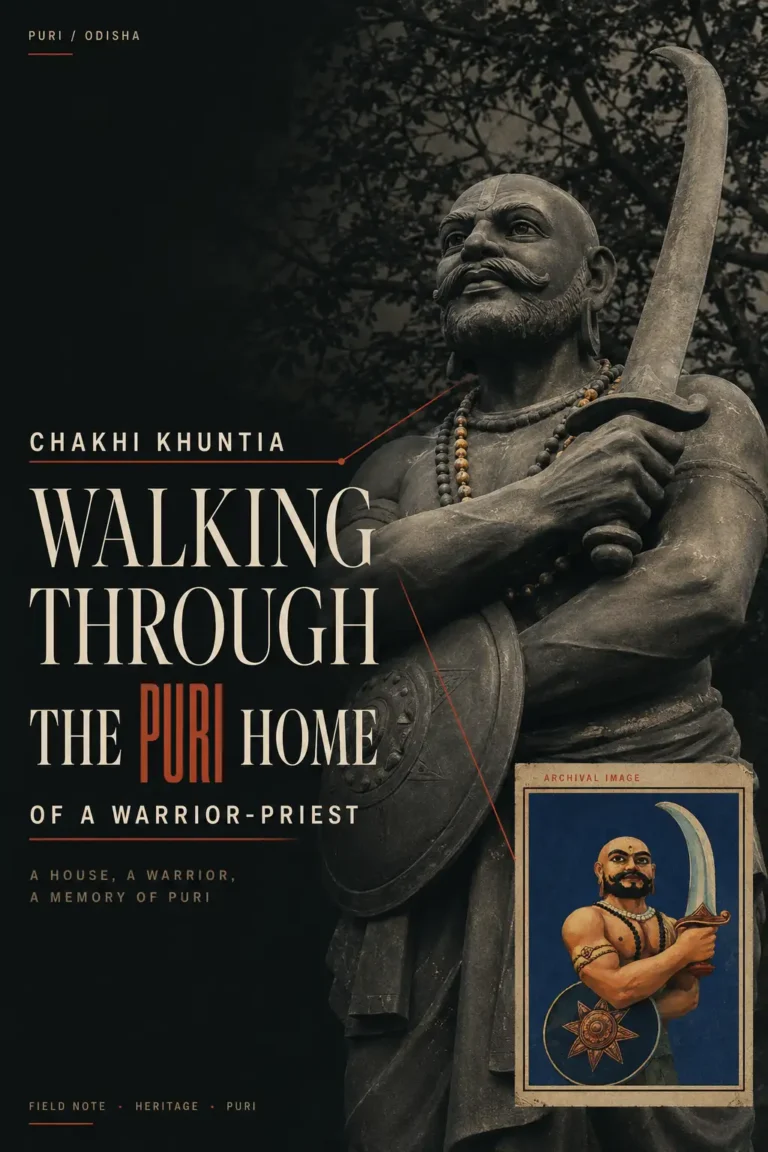
One such place for me is the home associated with Chandan Hajuri, popularly known as Chakhi Khuntia. Whenever I go on heritage walks through the old neighbourhoods of Puri, I feel particularly drawn towards this place. As a woman from Puri, walking through these familiar lanes and stopping at a house connected with a freedom fighter makes history feel surprisingly intimate.
We usually learn about the freedom struggle through textbooks, famous battlefields and monumental memorials. But here, in the old quarters of Puri, the story comes closer to home.Table of Contents
Who was Chakhi Khuntia?
Chakhi Khuntia is remembered as a Jagannath Temple servitor, poet, wrestler, social reformer and revolutionary who became associated with the Indian uprising of 1857.
His original name was Chandan Hajuri. According to the historical accounts, he was born in 1822, on the auspicious occasion of Shamba Dasami into the Hajuri family of Puri. His father, Raghunath Khuntia, was a servitor of Lord Jagannath, and his mother was Kamalabati. The Government of Odisha identifies his birthplace as Harchandi Sahi, Puri.
The old biographies I went through while preparing for my heritage walks also portray him as a person whose life combined devotion to Lord Jagannath, physical strength, learning and patriotism. The attached books Biplabi Bira Chakhi Khuntia, Chandana Hajuri and Amara Charita Chakhi Khuntia contain illustrated biographical accounts of his life and personality.
Why was he called Chandan Hajuri?
The name Chandan Hajuri has a beautiful connection with Lord Jagannath.
According to the traditional account, Chakhi Khuntia was born while his father was performing the Chandan Lagi (applying sandalwood paste) service of Lord Jagannath. Because of this association with sandal paste (chandan), he was given the name Chandan Hajuri.
For someone from Puri, this connection is especially meaningful. Here, the Jagannath tradition is not something separate from everyday life. It runs through families, professions, neighbourhoods and generations.
Why Was He Called Chakhi Khuntia?
The story behind the name Chakhi Khuntia is equally fascinating. He was known for his love of food and his habit of tasting different delicacies, from Mahaprasad to popular snacks such as Aloo Dum and Ghuguni on the Grand Road of Puri. It was also said that whenever a feast was being held, he would make sure to be there to taste the food.
In Odia, the word “Chakhiba” means to taste. Over time, this association with his fondness for tasting food led to the popular name “Chakhia,” and eventually “Chakhi Khuntia.”
From a Jagannath Servitor to a Revolutionary
At first glance, Chakhi Khuntia's life may seem to belong entirely to the world of the Jagannath Temple.
He was a Sevayat, guiding pilgrims who came to Puri from different parts of India. This profession also gave him an unusual opportunity to travel and meet people from outside Odisha.
He learned Odia, Sanskrit and Hindi, with Hindi being particularly useful in communicating with pilgrims from northern India. He was also deeply interested in the history, geography and heroic traditions of India.
Alongside his intellectual interests, he trained in wrestling and traditional physical exercises at the Jagaa akhadas of Puri. Later, he taught wrestling and indigenous military exercises to young people.
This combination of religion, travel, physical training and knowledge of the wider country became important in his later life.
What was Chakhi Khuntia's connection with Rani Lakshmibai?
This is perhaps the most fascinating part of his story.
Chakhi Khuntia became the family priest or Panda of Manubai, the young woman who later became famous as Rani Lakshmibai of Jhansi after her marriage to Maharaja Gangadhar Rao.
In reference with the book ‘Biplabi beera Chakhi Khuntia’ by H.K. Patra, his relationship with the Jhansi royal family continued even after Lakshmibai's marriage. Historical accounts describe him as someone who maintained contact with her and later became associated with the resistance against British rule.
His position as a Jagannath Panda gave him access to military cantonments and soldiers from northern India. He travelled widely in connection with his profession and came into contact with Indian sepoys.
During the Revolt of 1857, British authorities suspected him of helping to mobilise Indian soldiers and maintaining connections with the rebel leadership. The Government of Odisha describes him as having played a role in fomenting the uprising from the background.
How did Chakhi Khuntia become known as the "Sepoy Panda"?
This is one of the most interesting aspects of his story.
Pandas of Puri travelled to different parts of India to maintain relationships with pilgrims and invite them to visit Lord Jagannath. Chakhi Khuntia's travels brought him into contact with Indian soldiers stationed in northern military cantonments.
Because of his connections with the sepoys, he became known as a "Sepoy Panda" (sipahi panda) or Hajuri Panda.
British officials became suspicious of his activities during the 1857 uprising. He was arrested in Bihar/Gaya and his property was confiscated. Following the British amnesty associated with Queen Victoria's 1858 proclamation, he was released.
This is an important distinction when discussing Odisha's freedom struggle: Chakhi Khuntia is primarily associated with the Revolt of 1857, rather than the Paika Rebellion of 1817. The Paika Rebellion belongs to an earlier phase of resistance, led by Buxi Jagabandhu.
My Experience: Why I Love Visiting Chakhi Khuntia's Home
For me, this is where the historical story becomes personal.
Whenever I am on a heritage walk in Puri, I find myself fascinated by old houses and neighbourhoods that still retain connections with people from the past. The home associated with Chakhi Khuntia is one of those places that makes me pause.
I am not looking at a grand palace.
I am looking at a traditional house in the old city.
And that is precisely what makes the experience special.
As a woman of Puri, I have walked through these lanes many times. Yet heritage walks have changed the way I look at them. A lane that once seemed ordinary suddenly becomes part of a larger historical map.
When I stand near Chakhi Khuntia's home, I find myself imagining the Puri of the nineteenth century, the pilgrims moving towards the Jagannath Temple, the servitors going about their duties, the traditional akhadas where young men trained, and a young Chandan Hajuri growing up in this environment.
It makes me wonder how someone rooted so deeply in the spiritual life of Puri eventually became connected with one of India's most important anti-British uprisings.
What makes the house special to me?
The biggest attraction for me is not architectural grandeur.
It is the human story attached to the place.
The Government's tourism information lists Chakhi Khuntia's House among Puri's important tourist points and notes that his descendants continue to live there. It also says that visitors can arrange a visit through people living at the house. ([gajapati.uneecopscloud.com](https://gajapati.uneecopscloud.com/en/odisha-tourism/important-tourist-pointspuri?utm_source=chatgpt.com))
That makes the experience very different from visiting a conventional museum.
There is a feeling that the history has not completely disappeared.
It continues through the family, the neighbourhood and the memories associated with the house.
A Warrior, a Devotee and a Poet
Another reason I admire Chakhi Khuntia is that his identity cannot be reduced to "freedom fighter".
He was also deeply connected with Lord Jagannath.
After the turbulent years associated with the uprising, his later life was spent in Puri, where he returned to spiritual and literary pursuits. Historical accounts attribute poems and songs dedicated to Jagannath to him.
People still love singing the song ‘Thaka mana chaala jiba, chaka nayana dekhibaa…. When they set their trip to Puri.’
This combination fascinates me:
a priest who became a revolutionary,
a wrestler who became a poet,
and a pilgrim guide who became connected with the soldiers of a national uprising.
It makes his story much richer than a simple chapter in a history book.
What Can We Learn from Chakhi Khuntia's Story?
His life reminds me that freedom fighters did not always emerge from conventional political backgrounds.
Some came from:
- temples and religious institutions
- traditional communities
- village and urban neighbourhoods
- akhadas and physical-training centres
- professions that allowed them to travel and meet people across India
Chakhi Khuntia's life demonstrates how Puri's religious and cultural networks could also become networks of communication and resistance during colonial times.
Chakhi Khuntia and Puri's Living Heritage
For me, this is ultimately why heritage walks matter.
Puri's heritage is not limited to the Jagannath Temple, Rath Yatra or famous monuments. Its history also survives in sahis, old houses, akhadas, families, streets and stories.
Chakhi Khuntia's house is one such reminder.
The official Puri district website itself lists Chakhi Khuntia among the eminent personalities born in the district.
When I visit places like this, I feel that I am not simply "seeing" history. I am walking through it.
And perhaps that is the most beautiful thing about being a heritage enthusiast in Puri; the history I am searching for is often just around the corner.
Frequently Asked Questions
Who was Chakhi Khuntia?
Chakhi Khuntia, also known as Chandan Hajuri, was a Jagannath Temple servitor, Panda, poet, wrestler and revolutionary associated with the Indian Revolt of 1857.
Where was Chakhi Khuntia born?
Historical and government sources identify his birthplace as Harchandi Sahi in Puri, Odisha, where he was born in 1827.
What was Chakhi Khuntia's connection with Rani Lakshmibai?
He was associated with the family of Manubai, who later became Rani Lakshmibai of Jhansi, and maintained a relationship with the Jhansi royal family. Historical accounts connect him with the resistance during the 1857 uprising.
Why is Chakhi Khuntia important in Odisha's history?
He represents an important connection between Puri's Jagannath tradition and the wider Indian resistance against British rule during the Revolt of 1857.
Is Chakhi Khuntia associated with the Paika Rebellion?
Not directly. The Paika Rebellion of 1817 preceded his major role in the 1857 uprising. Chakhi Khuntia is principally remembered for his activities connected with the Revolt of 1857.
Can visitors see Chakhi Khuntia's house in Puri?
The Odisha tourism information lists his house as an important tourist point and states that a visit can be arranged through the people living there.
My Key Takeaway
Every time I visit Chakhi Khuntia's home during a heritage walk, I am reminded that heritage is not always grand or monumental.
Sometimes it is a narrow lane.
Sometimes it is the story of a person whose name survives in the memory of a city.
For me, Chakhi Khuntia Odisha is exactly that, a story where Puri's devotion, culture, physical traditions and India's freedom struggle meet in one remarkable life.
And walking to his home is, in its own small way, walking through that history.
About The Author

Jyotsna Mohapatra