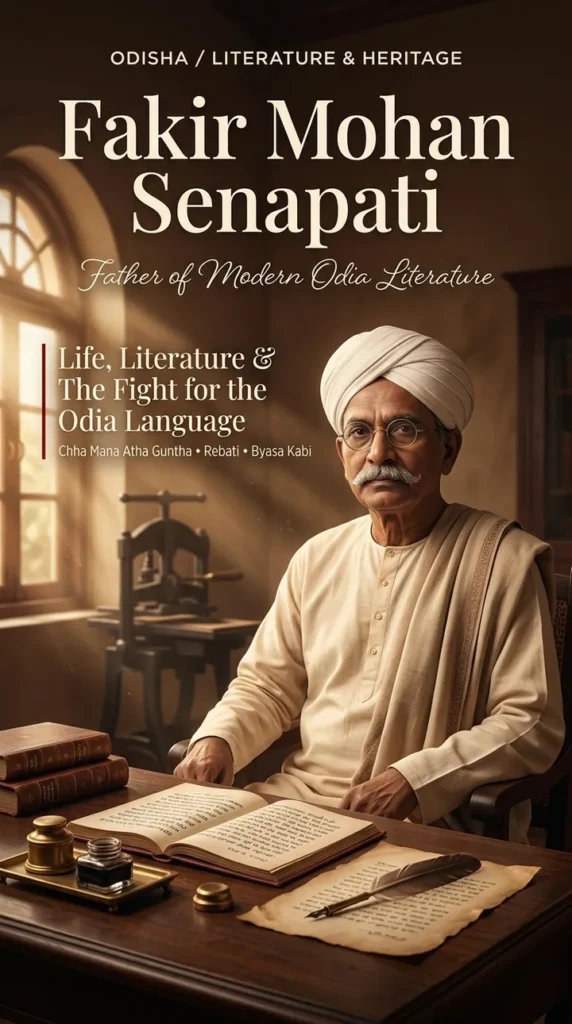
Who Was Fakir Mohan Senapati?
Fakir Mohan Senapati was born on 13 January 1843 at Mallikashpur in Balasore.
His parents were Lakshman Senapati and Tulasi Devi. He was their only child.
His childhood, however, changed very early. He lost his mother when he was about two years old and was brought up by his grandmother, Kochila Dei.
His birth name was not Fakir Mohan. It was Bajramohan. The name by which Odisha remembers him came later.
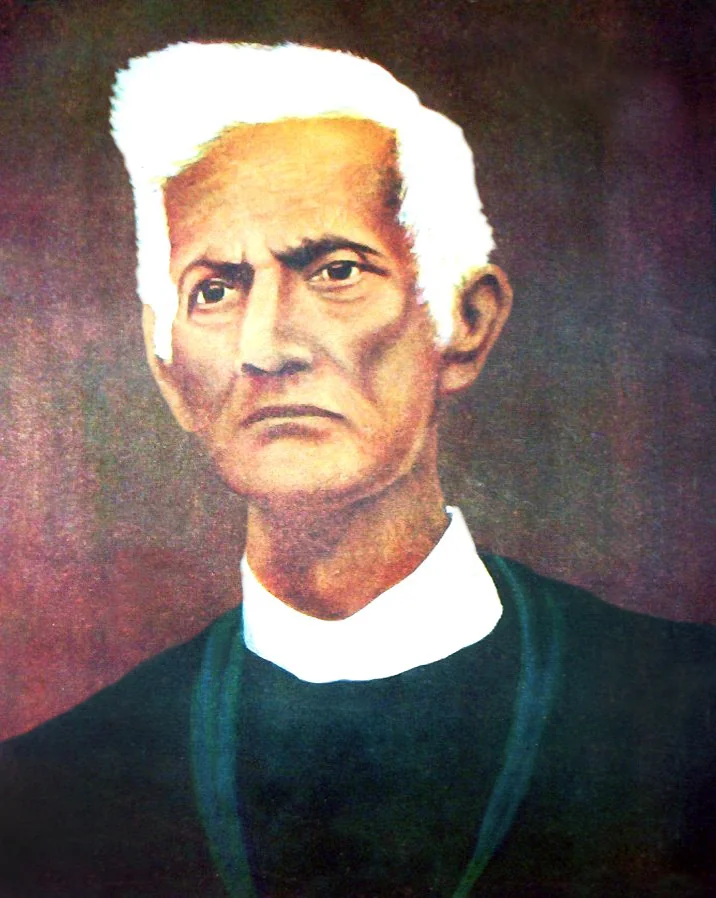
How Bajramohan Became Fakir Mohan
According to the biographical account, Kochila Dei offered young Bajramohan to a Sufi Pir during a severe childhood illness.
From that spiritual association came the name Fakir Mohan. The name remained throughout his life.
What began as part of his childhood identity eventually became one of the most recognisable and revered names in Odia literary history.
His Education Did Not Follow an Easy Path
Fakir Mohan first studied in a traditional village chatasali. He later spent some time at a Persian school.
In 1857, he enrolled at Barabati School in Balasore. But his formal education did not continue smoothly.
During the final stage of his schooling, he was unable to pay the monthly fees and had to stop studying. That financial hardship could have ended his intellectual journey.
It did not. Fakir Mohan continued learning through intense self-effort, mastering Sanskrit, Bengali and English. That rigorous self-education later became the bedrock of his career as a teacher, writer, administrator and translator.
From Student to Teacher
A vacancy for a third teacher opened at Barabati School, and Fakir Mohan entered the teaching profession.
Later, when the post of head teacher at a mission school became vacant, he was appointed to the position at a monthly salary of ₹30.
During this period, he also began writing textbooks. This is an important part of his career because Fakir Mohan’s concern for language was never limited to elite literary prestige.
Education mattered. Textbooks mattered. What children studied in primary school mattered. His later historic fight for the institutional survival of Odia in schools stemmed directly from this early classroom conviction.
A Difficult Personal Life
Fakir Mohan’s personal life was marked by deep bereavement. His first wife passed away shortly after their marriage. He later married Krishna Kumari, who became his enduring companion and source of emotional strength.
The biography recalls the tragic death of their young son, a loss that plunged his wife into inconsolable grief. In that dark hour, Fakir Mohan is remembered as comforting her with words that echo through generations:
“This book is our son. One day, it will keep our name alive.”
The words were prophetic. More than a century later, his literary creations remain immortal.
Fakir Mohan the Administrator
Literature was only one dimension of his working life. Fakir Mohan was also widely respected as a capable and fearless administrator.
After leaving teaching, he spent approximately 25 years serving as Dewan (Chief Administrative Minister) in various princely states across Odisha, including Nilgiri, Dampara, Dhenkanal, and Keonjhar.
That quarter-century of governance exposed him directly to raw political power, feudal bureaucracy, oppressive zamindars, caste hierarchies, and the everyday hardships of common ryots and peasants.
Those hard realities became the lifeblood of his fiction. His stories rarely feel detached or romanticised; they are populated with living, breathing human beings grappling with property rights, debt, authority, and systemic injustice.
John Beames and Fakir Mohan
During his time in Balasore, British scholar, administrator and linguist John Beames became a close associate and admirer of Fakir Mohan’s scholarship.
Beames, an authority on comparative Indo-Aryan languages, found in Fakir Mohan a brilliant native scholar who possessed deep knowledge of Odia philology, idioms, and oral traditions.
This scholarly alliance proved vital. In the late 19th century, when anti-Odia factions argued that Odia was merely a corrupt dialect of Bengali and should be erased from schools, Beames and Fakir Mohan provided the rigorous historical and linguistic proof establishing Odia as an independent classical tongue.
President of Utkal Sammilani
In 1917, Fakir Mohan was elected President of the Utkal Sammilani at its annual session in Cuttack.
By then, his stature had transcended literature. He had become a national elder and father figure of the Odia renaissance, closely aligned with Utkal Gourav Madhusudan Das in the campaign for a unified linguistic state, which laid the foundation for modern Odisha Culture and statehood.
The Period When Odia Language Faced a Crisis
The mid-to-late nineteenth century was a perilous era for Odia identity. Odisha had not yet been formed as a separate province; its territories were fractured across the Bengal Presidency, the Central Provinces, and the Madras Presidency.
Colonial administrators and non-Odia bureaucrats argued that Odia was not an independent language and pushed to replace it with Bengali in all schools and government courts.
Fakir Mohan responded with relentless energy across three vital fronts:
- In Schools: He campaigned vigorously for Odia-medium education and drafted school curricula.
- In Textbooks: He personally authored Odia grammar books, arithmetic manuals, and primers to ensure schools had quality native materials.
- In Literature: He proved through his prose that Odia was a rich, sophisticated vehicle capable of expressing the highest nuances of modern thought and social reality.
The Printing Press That Reached Balasore by Bullock Cart
One of the most heroic chapters in modern Odia history is Fakir Mohan’s quest for a printing press.
Realising that a language cannot survive without the physical infrastructure of print, Fakir Mohan pooled scarce personal savings, took loans, and traveled to Calcutta to purchase a hand-operated printing machine.
In 1868, he transported this heavy cast-iron press across hundreds of miles of muddy rivers and unmetalled roads to Balasore on a bullock cart, establishing the Utkal Press.
It was the first indigenous printing press in Balasore and only the third in all of Odisha. The press provided the newborn Odia public sphere with its voice.
Bodhadayini and Balasore Sambad Bahika
Through his newly established press, Fakir Mohan launched two epoch-making periodicals:
- Bodhadayini: A dedicated literary journal published to encourage native writers and modern essays.
- Balasore Sambad Bahika (1868): A pioneering Odia newspaper that reported news, exposed administrative malpractice, advocated social reform, and served as the vanguard for the Odia language protection movement.
Why Fakir Mohan Is Called Katha Samrat
Fakir Mohan brought ordinary society into Odia fiction. Prior to his arrival, Odia writing was largely dominated by ornate medieval verse, Sanskritised court poetry, and mythological retellings.
Fakir Mohan shattered this elitism. Into his stories walked real, gritty human beings: impoverished weavers, cunning village touts, greedy zamindars, tyrannical police officers, suffering widows, and innocent rural girls.
He employed the authentic, earthy colloquial idiom of everyday Odia life, rich in proverbs, dry wit, and biting irony. Because he gave Odia fiction its first realist masterpieces, he is venerated as Katha Samrat (Emperor of Storytelling).
Chha Mana Atha Guntha
Among Fakir Mohan’s masterworks, Chha Mana Atha Guntha (Six Acres and Thirty-Two Decimals), serialised between 1897 and 1899, stands as a supreme monument of Indian realism.
The novel revolves around the unbridled greed of Mangaraj, an unscrupulous zamindar who schemes to seize the fertile smallholding of a pious and innocent village weaver couple, Bhagia and Saria.
The narrative exposes the predatory nexus of colonial land revenue laws, corrupt police, dishonest lawyers, and feudal cruelty. Written with savage irony, it demonstrates that true justice rarely comes from colonial courts, but inexorable moral retribution catches up with the oppressor.
His Major Novels
Fakir Mohan authored four major novels that established the modern Odia novel as an instrument of social analysis:
- Chha Mana Atha Guntha: An unmatched study of agrarian feudalism, legal deception, and human tragedy.
- Lachhama: A rich historical novel depicting the horrors of 18th-century Maratha Bargi raids in Bengal and Odisha, celebrating patriotic resistance.
- Mamu (The Maternal Uncle): A sharp domestic critique focusing on the greed of an administrative clerk (Nazar Natabar Das) attempting to disinherit his widowed sister's children.
- Prayaschitta (The Expiation): An insightful exploration of generational clash between orthodox Hindu values and modern, English-educated youth.
Fakir Mohan and the Odia Short Story
Fakir Mohan is recognised as the father of the modern Odia short story. His collection Galpa Swalpa contains timeless masterpieces that blend humour, tragedy, and keen social observation:
- Rebati: The tragic story of a young girl whose desire for education is crushed by family misfortune and orthodoxy.
- Patent Medicine: A humorous satire on an unfaithful husband, alcoholism, and the unorthodox "home remedy" applied by his resourceful wife.
- Randipua Ananta: The story of a brave village rogue whose selfless heroism saves his village during a devastating flood embankment breach.
- Sabhya Zamindar: A biting critique of an Anglicised young landlord who squanders his ancestral inheritance in western-style extravagance while despising his native culture.
- Dak Munshi: A heartbreaking portrait of an ungrateful son who rises to government service and subsequently humiliates and expels his devoted old father.
- Birei Bisal, Adharma Bitta, Suna Bohu, Bagala Baguli, Dhulia Baba: Stories exploring social hypocrisy, fake godmen, village solidarity, and moral integrity.
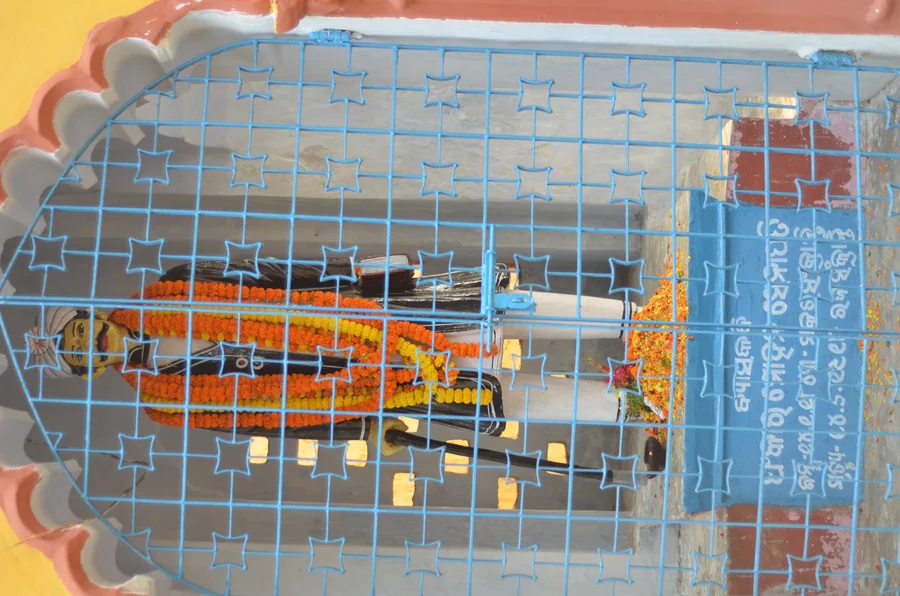
Rebati
Published in 1898 in the literary magazine Utkal Sahitya, Rebati is widely acknowledged as the very first modern short story in Odia literature.
It tells the poignant story of Rebati, an innocent village girl in rural Cuttack who longs to learn reading and writing under the tutelage of a progressive schoolteacher. When cholera devastates her family, her superstitious grandmother blames Rebati's education for the family's ruin.
The story remains an unforgettable indictment of patriarchal superstition and the denial of education to women in 19th-century India.
Social Reform Through Literature
Fakir Mohan never viewed literature as mere ornamental art. Every novel and story he crafted was an act of moral conscience and social reform.
He exposed the evils of child marriage, the plight of childless widows, the rapacity of money-lenders, the hypocrisy of caste elders, and the blind imitation of colonial manners. Alongside the visual traditions of art and crafts of Odisha and the poetic movement led by Radhanath Ray, his literature formed the bedrock of Odia cultural awakening.
Why He Is Compared With Thomas Hardy
Literary critics frequently compare Fakir Mohan Senapati to English novelist Thomas Hardy. Both writers emerged from provincial backgrounds, possessed intimate familiarity with rural dialect and agrarian rhythms, and portrayed ordinary country folk with tragic dignity and realistic fidelity.
Just as Hardy immortalised the rustic inhabitants of Wessex, Fakir Mohan immortalised the farmers, weavers, and village folk of coastal Odisha, earning him the affectionate title of the “Thomas Hardy of Odisha.”
Fakir Mohan as a Translator
Recognising that a modern vernacular literature needs access to timeless classics, Fakir Mohan dedicated years to translating monumental epics from Sanskrit into musical, accessible Odia verse:
- The Ramayana (Balmiki Ramayana in Odia verse)
- The Mahabharata (complete 18 parvas translated into lucid Odia)
- The Srimad Bhagavad Gita and the Upanishads
- Jiban Charita: Translated Ishwar Chandra Vidyasagar's famous biography from Bengali into Odia for school readers.
For these magnificent epic translations, the scholars of Utkal conferred upon him the revered title Byasa Kabi (honouring him in the tradition of sage Vyasa).
Utkal Bhramanam
In 1892, Fakir Mohan published Utkal Bhramanam (A Tour of Odisha), a pioneering satirical travelogue written in spirited verse.
In it, he journeyed across different parts of historical Odisha, offering sharp, humorous observations on the social landscape, local customs, feudal vanity, and the urgent necessity of cultural unity.
A Literature Built Around Odia Life
What makes Fakir Mohan Senapati uniquely beloved is his total immersion in native Odia reality. His pages crackle with the salty air of Balasore, the red soil of the feudatory garhjats, the muddy riverbanks of the Mahanadi, and the spoken idioms of ordinary households.
He did not borrow foreign settings or sterile academic language; he built an authentic literary universe straight from the soil of Odisha.
“Satyameva Jayate” and His Literary Outlook
The philosophical motto “Satyameva Jayate” (Truth Alone Triumphs) forms the moral anchor of Fakir Mohan’s writings.
While his realist narratives never shy away from portraying cruel oppression, he relentlessly demonstrated that vanity, falsehood, and greed ultimately crumble before cosmic moral order and the indestructible dignity of truth.
Why Fakir Mohan Still Matters
Fakir Mohan Senapati is not merely a figure preserved in historical textbooks. He is the guardian spirit of the Odia language.
When the language was in danger of extinction in colonial institutions, he physically defended it, printed it, taught it, and gave it masterpieces that proved its classical stature to the world.
Every time modern Odias celebrate cultural milestones — whether gathering for the Nuakhai harvest festival, observing Kartika Masa, or reading vernacular literature — they inherit a cultural freedom protected by Fakir Mohan Senapati.
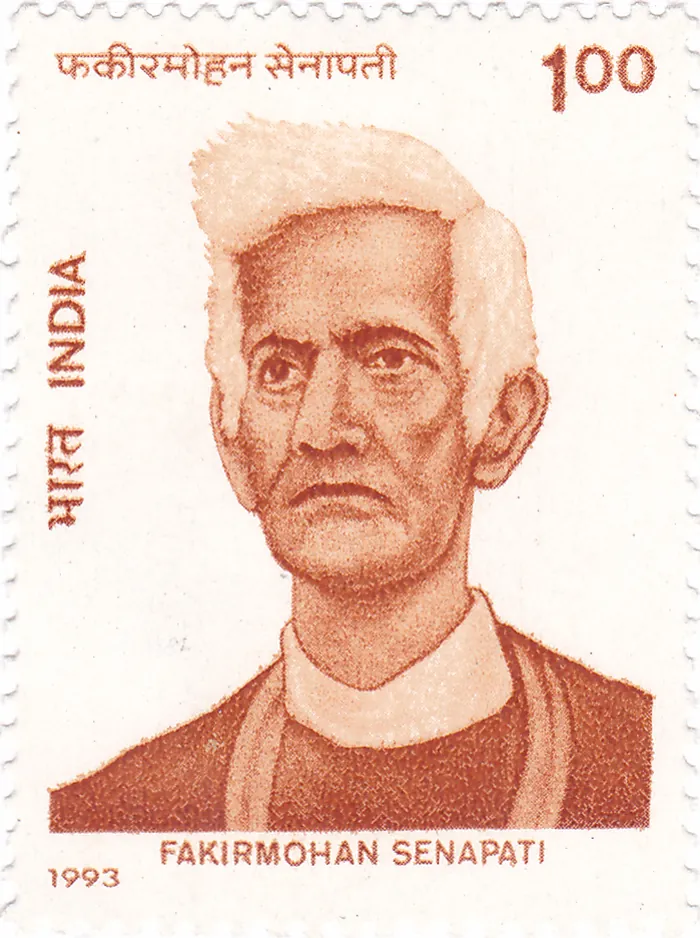
Fakir Mohan Senapati Quick Facts
| Category | Details |
|---|---|
| Full Name | Fakir Mohan Senapati |
| Original / Birth Name | Bajramohan Senapati |
| Date of Birth | 13 January 1843 |
| Place of Birth | Mallikashpur, Balasore, Odisha |
| Parents | Lakshman Senapati (Father) & Tulasi Devi (Mother) |
| Raised By | Grandmother Kochila Dei |
| Professions | Writer, Educator, Administrator (Dewan), Translator, Publisher & Social Reformer |
| Administrative Career | Around 25 years as Dewan in princely states (Nilgiri, Dampara, Dhenkanal, Keonjhar) |
| Utkal Sammilani | President in 1917 |
| Popular Titles | Byasa Kabi, Katha Samrat |
| Major Novels | Chha Mana Atha Guntha (1897), Lachhama (1901), Mamu (1913), Prayaschitta (1915) |
| Famous Short Stories | Rebati (1898), Patent Medicine, Randipua Ananta, Sabhya Zamindar, Dak Munshi, Suna Bohu |
| Periodicals Founded | Bodhadayini and Balasore Sambad Bahika (1868) |
| Major Translations | Ramayana, Mahabharata, Srimad Bhagavad Gita, Upanishads into Odia |
| Autobiography | Atma Jeevana Charita (The first autobiography in Odia literature) |
| Date of Passing | 14 June 1918 (Balasore) |
Conclusion
Fakir Mohan Senapati’s life cannot be reduced to a list of publications. The larger, inspiring story is about what he achieved with a beleaguered language.
He taught in Odia. He wrote textbooks in Odia. He hauled a printing press by bullock cart to print in Odia. He published journals in Odia. He translated the immortal epics into Odia.
And then, he used fiction to hold a mirror up to Odia society, giving voice to the voiceless and demonstrating the dignity of common people.
When his wife grieved the loss of their child, Fakir Mohan assured her that their books would one day keep their name alive. Today, that name shines brighter than ever — not only in libraries, but in the proud, living voice of forty-five million Odias.
Explore More: Odisha Great Personalities & Literary Heritage Cluster
Discover more about Odisha's legendary freedom fighters, poets, spiritual icons, and cultural history across LocalDrive:
- Visionaries & Heroes: Read our comprehensive guide to Great Personalities of Odisha: Freedom Fighters, Poets & Saints.
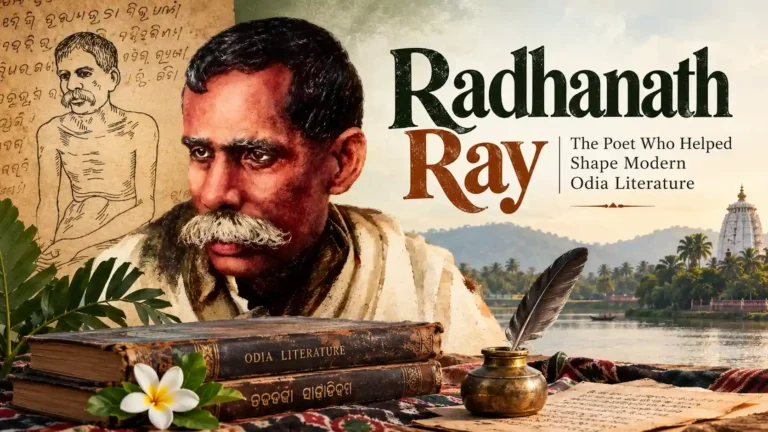
- Poetic Renaissance: Explore the life and works of modern Odia poetry's father in Radhanath Ray: The Poet Who Helped Shape Modern Odia Literature.
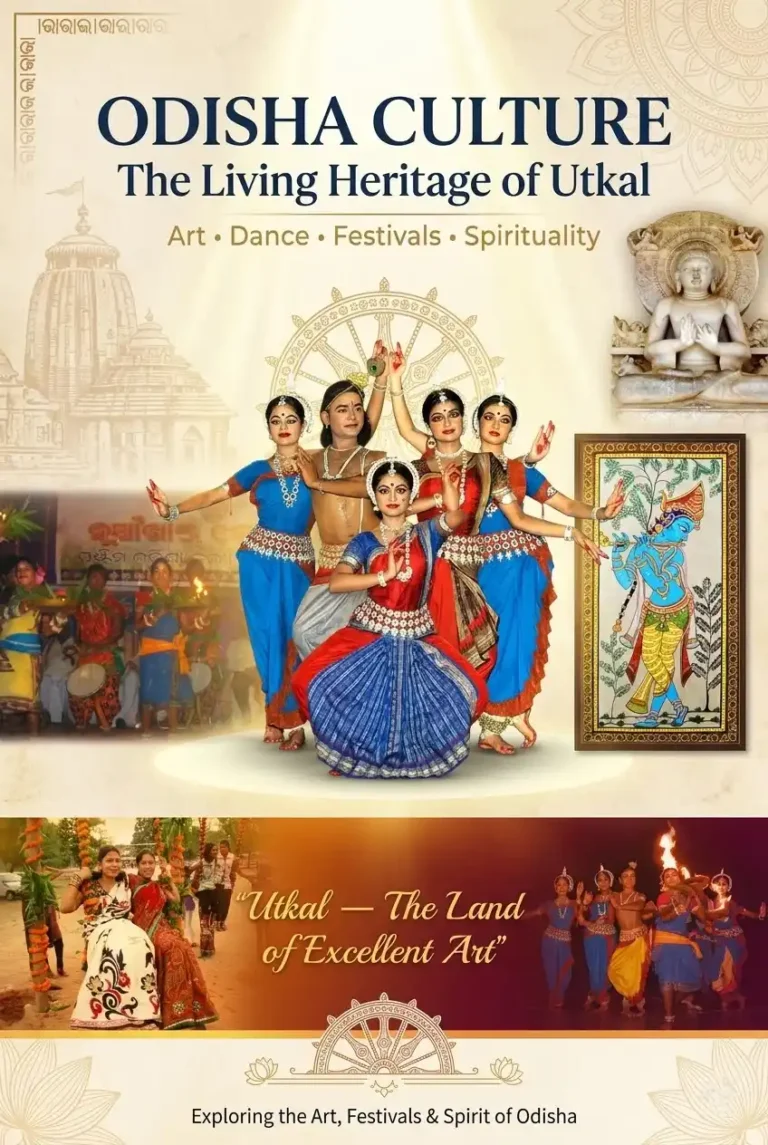
- Living Soul of Utkal: Discover the art, rituals, and philosophy of the state in Odisha Culture: The Living Soul of Utkal – Art, Traditions, Festivals & Heritage.
- Art, Handlooms & Craftsmanship: Explore Pattachitra, Sambalpuri bandha, and stone carvings in Art & Crafts of Odisha: Dance, Painting, Handloom & Where to See Them.
- Architect of Modern Odisha: Learn about the freedom struggle and political leadership in Harekrushna Mahtab: Life, Freedom Struggle, Political Career and Legacy.
- Patriot of Cuttack: Walk through the birthplace and legacy of India's revolutionary hero in Netaji Subhas Chandra Bose & Kataka: The Janakinath Bhawan Guide.
Frequently Asked Questions About Fakir Mohan Senapati
Who was Fakir Mohan Senapati?
Fakir Mohan Senapati (1843–1918) was a pioneering Odia novelist, short-story writer, poet, educator, administrator, and publisher, widely revered as the "Father of Modern Odia Literature" and the chief defender of the Odia language during its 19th-century crisis.
When was Fakir Mohan Senapati born?
He was born on 13 January 1843 at Mallikashpur village in Balasore district, Odisha.
What was Fakir Mohan’s original name?
His birth name was Bajramohan Senapati.
Why was he called Fakir Mohan?
During a critical childhood illness, his paternal grandmother Kochila Dei dedicated him to a Muslim Sufi Pir (saint) in prayer for his recovery. In gratitude, she renamed him "Fakir Mohan" (meaning a beggar or mendicant of the divine), and the name remained for life.
Who were Fakir Mohan Senapati’s parents?
His father was Lakshman Senapati and his mother was Tulasi Devi. Having lost both parents in early childhood, he was raised under the loving care of his grandmother Kochila Dei.
Why is Fakir Mohan called Byasa Kabi?
He was honoured with the prestigious title Byasa Kabi by scholars and intellectuals of Odisha because he single-handedly translated the vast Sanskrit epics — the Ramayana, the Mahabharata, the Bhagavad Gita, and the Upanishads — into accessible, melodious Odia verse, walking in the footsteps of ancient sage Vyasa.
Why is Fakir Mohan called Katha Samrat?
He is known as Katha Samrat (Emperor of Storytelling) because he pioneered realist storytelling and prose in Odia, capturing the raw, vibrant lives, struggles, humour, and dialect of common rural folk.
What are Fakir Mohan’s major novels?
His four classic novels are Chha Mana Atha Guntha (1897), Lachhama (1901), Mamu (1913), and Prayaschitta (1915).
What are some famous short stories by Fakir Mohan?
His famous short stories include Rebati, Patent Medicine, Randipua Ananta, Sabhya Zamindar, Dak Munshi, Birei Bisal, Adharma Bitta, Suna Bohu, Bagala Baguli, and Dhulia Baba.
What did Fakir Mohan do for the Odia language?
During the 19th-century language movement when Odia was threatened with exclusion from schools, Fakir Mohan established the Utkal Printing Press in Balasore, published textbooks and newspapers, fought colonial bureaucracy alongside John Beames, and proved Odia's classical literary richness through his own writing.
Which newspapers or journals did Fakir Mohan publish?
He founded and published Bodhadayini (a literary and cultural journal) and Balasore Sambad Bahika (a historic weekly newspaper launched in 1868).
Did Fakir Mohan work as an administrator?
Yes. Following his career as a school headmaster, he served with distinction for nearly 25 years as Dewan (Prime Administrative Minister) in various feudatory princely states including Nilgiri, Dampara, Dhenkanal, and Keonjhar.
When did Fakir Mohan become president of Utkal Sammilani?
He was elected President of the Utkal Sammilani in 1917 at its historic annual session held in Cuttack.
Why is Fakir Mohan compared with Thomas Hardy?
Both authors focused intensely on rural society, depicting the tragedy, economic hardships, and social dynamics of agrarian folk with unsentimental realism and native regional authenticity.
What is Utkal Bhramanam?
Utkal Bhramanam (1892) is a pioneering satirical verse travelogue authored by Fakir Mohan Senapati, recounting his journeys across Odisha while offering humorous commentary on contemporary personalities and society.
Why is Fakir Mohan important to Odisha?
Fakir Mohan gave the Odia people their modern narrative voice and self-respect. Without his tireless efforts as a writer, educator, and publisher, the Odia language might have lost its institutional standing in schools and governance during the colonial era.