The festivals and rituals associated with the Sri Jagannath Temple in Puri are distinctive because they beautifully reflect the traditions, beliefs, and everyday life of Odisha. What makes the rituals of Srimandir particularly fascinating is the way the deities are associated with the customs and responsibilities of an Odia household.
Lord Jagannath is often regarded as our own Odia God, and many of the rituals surrounding Him reflect the lifestyle and traditions of an Odia family. Goddess Mahalaxmi, in particular, is portrayed as the ideal Odia housewife. Within Srimandir, she performs various responsibilities associated with a household. She cooks food, takes care of the temple, looks after different matters, welcomes visiting deities and performs several other duties.
In this beautiful tradition, Maa Mahalaxmi also observes her duties and responsibilities as a homemaker. One such unique ritual is associated with Rushi Panchami, when Goddess Mahalaxmi visits the Markandeswar Shiva Temple in Puri.
What is Rushi Panchami?
Rushi Panchami is associated with an ancient Hindu ritual of penance. Traditionally, women who were menstruating were prohibited from performing certain household activities and puja during their menstrual period. These practices are described in traditional scriptures and are associated with the teachings attributed to ancient sages and saints.
Among the revered sages mentioned in Hindu tradition are Atri, Angira, Markandeya and Bhrigu. Interestingly, the four ashrams dedicated to these sages are located in Puri, close to the Sri Jagannath Temple.
According to the traditional belief, women perform Rushi Panchami Puja as an act of penance for any ritual restrictions or mistakes associated with the menstrual period.
In Puri, this tradition takes on a unique dimension because Goddess Mahalaxmi herself participates in the ritual.
Goddess Mahalaxmi's Visit to Markandeswar Temple
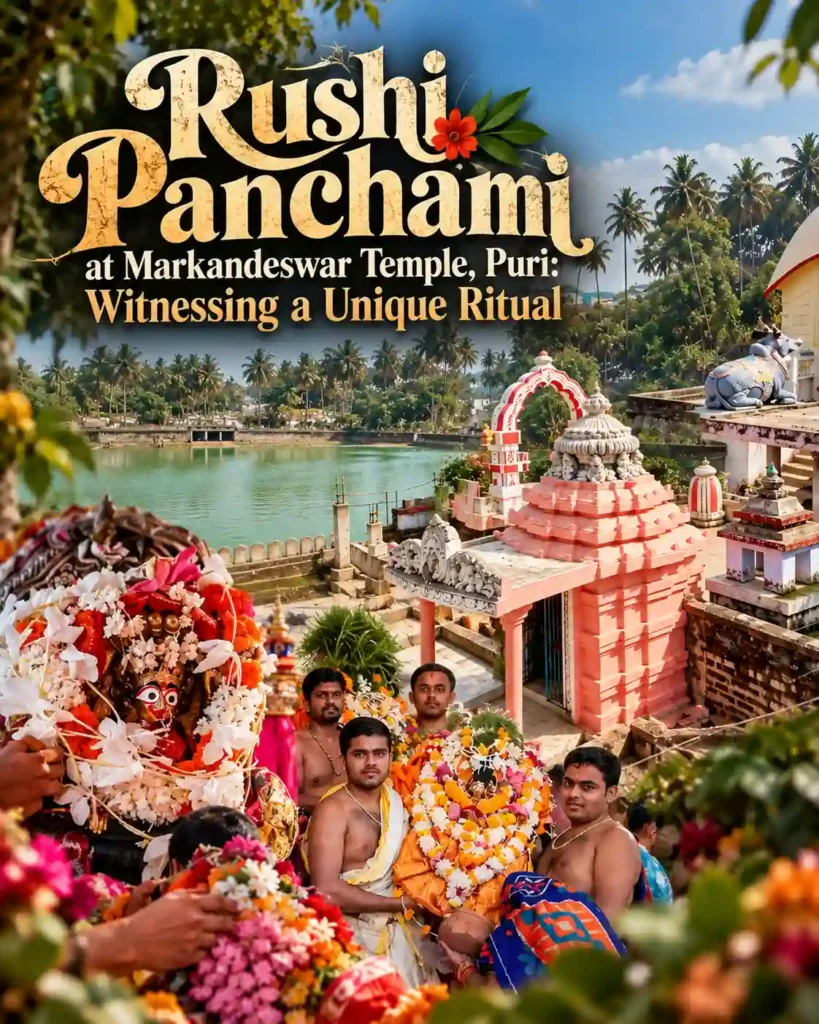
On the occasion of Rushi Panchami, Goddess Mahalaxmi comes out of Srimandir in a traditional palanquin and proceeds towards the Markandeswar Shiva Temple, located to the north of the Jagannath Temple.
At Markandeswar Temple, Lord Markandeswar Mahadev represents Sage Markanda, while Goddess Mahalaxmi performs the Rushi Panchami Puja.
The ritual is not limited to the Goddess alone. Local women also participate in the vrat. They observe a fast, visit the temple and take part in the puja. After the ritual, they receive Pana as Prasad, traditionally prepared with ingredients such as milk, banana, chhena and other offerings.
My Experience of Witnessing Rushi Panchami at Markandeswar Temple
This year, I had the opportunity to witness this beautiful ritual at Markandeswar Temple, Puri, and it was an experience I will cherish.
Markandeswar is regarded as one of the five chief Shiva temples of Puri. It is situated amidst the lanes of Markandeswar Sahi and holds immense religious and historical significance.
The temple complex also houses the Markanda Pond, which is considered one of the revered Panchatirtha, or five sacred water bodies, of Puri.
The temple itself is an important example of Odisha's traditional temple architecture. The Garbhagriha follows the Odisha Rekha Deula architectural style and features a Pancharatha plan. The Jagamohan follows the Pidha style. The temple's side deities include Goddess Parvati, Lord Ganesha and Lord Kartikeya.
The Legend Behind Markandeswar Temple
According to the temple priest, there is an interesting legend associated with Markandeswar.
During the first Pralaya, or cosmic dissolution, Sage Markanda is believed to have arrived at this place while floating on the waters. There, he witnessed Lord Krishna in the form of a child floating on a small leaf.
Sage Markanda worshipped the Lord. According to the legend, Lord Krishna advised him to remain there and worship Mahadev.
It is believed that this is how the Shiva Linga came to be known as Markandeswar—the Lord associated with Sage Markanda.
The temple is believed to date back to a period earlier than the present Sri Jagannath Temple, although it has undergone renovations over time.
The Procession from Srimandir
I reached Markandeswar Temple just before Goddess Mahalaxmi arrived.
After the completion of the morning Gopal Ballabh Bhog at Srimandir, the palanquin carrying Goddess Mahalaxmi begins its journey outside the temple.
Several servitors accompany the Goddess, including the Pujapanda and Singhari servitors.
Interestingly, the representative deity of Markandeswar Mahadev is also brought out in a procession before Goddess Mahalaxmi arrives.
Unlike many other temples, the representative idols of Markandeswar Mahadev remain inside the Jagannath Temple and are brought out to the main temple only during certain festivals and rituals.
Therefore, the Bimana of Markandeswar Mahadev arrives first at the Markandeswar Temple premises.
Being present during this procession was a deeply spiritual experience for me. The servitors brought out the idol of Markandeswar Mahadev, and devotees bowed before Him and touched His feet.
The Unique Form of Markandeswar Mahadev
One aspect that particularly caught my attention was the distinctive iconography of the Shiva idol.
Odishan representations of Shiva can have features that differ from those commonly seen in other parts of India. Here, Mahadev holds the Parasu and Mriga in His upper two hands, while His lower two hands are in Abhaya and Varada mudras.
Seeing this traditional form of Mahadev during such an important ritual made the experience even more special.
The Arrival of Goddess Mahalaxmi
Soon after, Goddess Mahalaxmi, the divine housewife of Mahaprabhu Jagannath, arrived.
As the chief lady of Srimandir, Goddess Mahalaxmi is taken outside with great care, reverence and respect.
Devotees were allowed to touch Her lotus feet. For me, this was an extremely emotional and blessed moment.
It was the first time I had the opportunity to come so close to the Goddess and touch Her feet. I truly felt blessed to witness Her arrival and be a part of this sacred ritual.
What is Majana Ritual?
After both deities arrived, a special bathing ritual known as Majana was performed by their respective servitors.
The word and ritual of Majana refer to the ceremonial bathing or freshening-up of the deities. In a simple way, it felt to me like the way we freshen ourselves after reaching a place following a long journey.
Watching the Majana ritual from close quarters was a memorable experience.
I was fortunate enough to witness the sacred bathing ritual and also receive the holy water served by the temple servitors.
Rushi Panchami Puja at Markandeswar Temple
After the Majana, the main ritual began.
The Pujapanda servitor recited the Rushi Panchami text while Lord Markandeswar Mahadev remained there in the role of Sage Markanda.
Goddess Mahalaxmi performed the vrat and puja, while local women also observed the ritual and fast alongside Her.
For me, this was perhaps the most fascinating aspect of the entire ritual.
The idea that Goddess Mahalaxmi herself comes out of Srimandir, observes the vrat and performs the Rushi Panchami Puja alongside local women beautifully demonstrates how the rituals of Lord Jagannath are deeply connected with the traditions and everyday life of Odisha.
A Living Tradition of Puri
The rituals of Srimandir are not simply religious ceremonies. They offer a glimpse into the social customs, traditions, mythology, architecture and cultural identity of Odisha.
Rushi Panchami at Markandeswar Temple is a beautiful example of this living tradition. Here, mythology, devotion and the customs of an Odia household come together in a unique ritual.
For me, witnessing this ritual was not merely a temple visit. It was an opportunity to observe a lesser-known aspect of the Jagannath tradition of Puri and understand how deeply the rituals of Srimandir are woven into Odia life.
After the completion of the puja, Goddess Mahalaxmi returned to Srimandir in the same ceremonial procession, bringing this beautiful ritual to an end.
Final Thoughts
Every visit to Puri seems to reveal another layer of the Jagannath tradition. Some rituals are grand and widely known, while others remain relatively intimate and less familiar to visitors.
Rushi Panchami at Markandeswar Temple is one such beautiful tradition.
Witnessing Goddess Mahalaxmi perform the vrat, watching the procession of Markandeswar Mahadev, experiencing the Majana ritual and being present during the puja gave me a deeper appreciation of the living traditions of Puri.
It reminded me once again that in the Jagannath culture, the divine is not always distant from everyday life, it is beautifully woven into the traditions, responsibilities and emotions of an Odia household.
About the Author
Jyotsna Mohapatra
Trending Posts